

Vol. II, No. 3
Friday, JuLY 4, 2025.
St. Paul, MN
A RIGHT HONORABLE Soldier
By Mrs. Jane Hadley.
IN WHICH the squad travels to their new post and faces the threat of impending battle.
IV.
Pittsburgh, Pennsylvania
Saturday, October 19, 1861
HENRY understood now why Jacob Robinson had been such a dope after his honeymoon. When he woke up on the floor of the Duquesne Gray’s hall with the rest of the regiment, it was like the sun shone just a little bit brighter. Charley was tucked under her wool blanket beside him, serene in her sleep. This wasn’t anything like a honeymoon trip down the Mississippi in a steamship, replete with a state room and universally acknowledged forbearance for their infatuation by the rest of the passengers, but it felt like something was forming between them, something new and fragile.
When she woke up, her dark eyes fluttered open and focused on him. She smiled, soft and open and sleep-rumpled. Henry locked the sight in his memory, to never forget the way she looked at him when she first woke up. It made him want to whisper sweet nothings in her ear, but the snort of Krüger waking and Jacob yawning snapped his awareness back into the wider world.
“Gut–Good morning,” he whispered. God, he was so smitten he forgot to speak English instead of German.
“It is a good morning, isn’t it?” she murmured, her voice rough and low, just for him to hear.
“Best I can recall. Best company, at any rate.”
Her bow lips twitched at the corners, her eyes crinkling.
“Aren’t you two just as snug as a bug.”
Henry looked up at Elias Hower, standing above them with hands on his hips. He was smiling, but something about it made Henry feel like it was forced.
“What’s got your goat?” Charley asked, her countenance closing as she swung her chin toward Hower.
He shook his head. “Best if it comes from the big bugs.”
Henry’s eyes widened. “You have news, but you’re not going to share it? Who are you, and what have you done with my corporal?”
Elias shifted on his heels, glancing at Charley. “I’d rather not be the messenger in this case.” He retreated before either of them could further engage him.
Charley shoved herself up to sitting, her brows fully furrowed in Smith fashion. So much for the blissful pocket of intimacy. She rolled her blanket quickly and swung it over her shoulder.
“Where are you going?” Henry couldn’t help but ask.
“What kind of question is that?” Smith rebutted, not so much snapping as lobbing with a more benign strain of derision. Henry sighed.
“Never mind.”
“Come on, we gotta get in ranks. Better get whatever this bad news is over with.” She stood, and Henry followed suit. He bundled his blanket into a roll, tied the corners, and slung it over his shoulder. “Will it be easier to swallow if you know something bad is coming or won’t it make much of a difference having fair warning?”
“I reckon it might be worse,” Charley admitted, pushing her hair back and affixing her cap. Her hair was getting a bit long, curling over her collar at the back of her neck. Henry wished he could bury his nose in it. “Now I’m imagining all sorts of miserable scenarios.”
“Maybe it’ll be a relief then?” Henry suggested.
“What’ll be a relief?” John Williamson said. He slept quite soundly to Henry’s other side, at least he had last night, well enough they could sneak away undetected. Apparently now he’d quite dispensed with his rest at the prospect of fresh news. Henry startled, because he’d been about to wonder aloud whether Charley had anything to worry about, and that would have set Williamson off in a line of questioning that might get both he and Charley in a heap of trouble.
“Hower baited us with bad news,” Charley grumbled.
“I heard that. I just wondered if you had any ideas of what it was about,” Williamson replied. “I had a letter from home saying the weather’s gone frigid and there’s Indians stealing chickens and the like. The harvest was bad at Yellow Medicine.”
Henry’s brow furrowed. It hadn’t occurred to him that the news might be of where they’d come from, rather than where they were headed. “Remind me where you’re from again?”
“North of Birch Coulee,” Williamson replied.
Henry frowned further. That was up in Indian Country, on the tract of land held in reserve for the Sioux.1
“I thought you were from Faribault?” Charley clarified.
“Well, I was, on account of that’s where I enlisted, but my mother lives near Birch Coulee.”
“But that’s the Indian Reservation,” Henry couldn’t help but argue. Williamson didn’t look like an Indian, but that didn’t mean much when so many men who’d come to Minnesota in the fur trade days made marriages with Indian women.
“Yes,” Williamson smiled, unaware—or unwilling—to clarify the question Henry didn’t ask. Henry looked to Charley, who shrugged. “I didn’t grow up there, of course,” Williamson offered.
“Where did you grow up?” Henry’s curiosity was fully engaged now.
“St. Paul, mostly. My father’s work takes him all over, but I went to school there.” He said it like Henry imagined someone might say they went to Harvard, with pride. St. Paul was practically wilderness compared to Boston, but a fellow deserved to be proud he could read and write and such, regardless of where he’d learnt it.
They’d fallen into ranks near the exit of the hall as they carried on their conversation. Sergeant Osborn was calling them to attention, so Henry didn’t have the chance to pursue any of the frayed threads Williamson had cast out any further. Williamson wasn’t the most perceptive fellow, but he wasn’t usually so fragmented. Perhaps because Henry hadn’t done much apart from try to avoid him, which now that he was acknowledging it, he felt rather guilty about.
“Who’s your father?” Charley hissed toward Williamson, even though they were supposed to be standing at attention. It appeared Henry was not the only one whose curiosity had been piqued.
“Smith—” Osborn scolded under his breath.
“John Williamson,” John Williamson replied.
Krüger laughed, which set Henry laughing too, then the whole squad was chuckling such that Osborn had to reprimand them.
Captain Noah stepped forward before the ranks to address them.
“Men,” he said, “I’ve been informed that our orders have been countermanded. Instead of heading to Washington D.C., we will be going downriver to join General Buell’s Army of the Ohio. We depart shortly, so any soldiers wanting to send word home had better do it presently.”
They were ordered at ease then, and in no time, the din of speculative murmurs rose to a fever pitch.
“Ohio?” Jacob Robinson said. “But they’re Union.
“Have Rebels invaded Ohio?” Williamson gasped.
“No,” Elias sauntered over. News broken, he appeared now ready to play benevolent oracle again. “They’re gathering Union troops in Kentucky, trying to keep them from seceding and ensuring the Rebs can’t get supplies through railroad lines or other means.”
“We’re not going to the front,” Charley clarified. She looked thunderous.
“I wouldn’t say that,” Elias replied. “There’s good information placing Rebel troops on the border of Kentucky and Tennessee. A General Jollification or something.”
“Zollicoffer,” Osborn broke in, eyeing Elias. “And I do have information you don’t, sometimes.”
“Zollicoffer?” Henry scoffed as he pulled canvas tight on their Sibley tent, Williamson and Robinson pulling from the other side. “And folks say my name is strange…”
Hower rolled his eyes. “He’s some sort of dandy merchant or something, got the command because he was friends with the top brass.”
Osborn gave the squad a withering look. “I’m not concerned we won’t see battle, if that’s what you’re worried about. There will be plenty to fight for in Kentucky.”
Charley’s jaw worked and flexed, but she said nothing. Henry shifted from one foot to the other as the reality of the decision curdled around him. No Washington D.C. No reuniting with his brother and the First Minnesota. If only he’d managed to get into the First, he would have had months of battle experience already. That one moment when the captain called for men with their own rifles, the one his brothers had seized and he had not, was making a bungle of his entire dream for enlistment. Now, instead of winning honor and glory, he was fated to dig earthworks and wait. A stretch of three years enlistment unfurling before him in an endless unknown. He’d grown up in Cincinnati—even then, all he knew about Kentucky was that it was the wrong side of the river.
⸻
The steamboats departed under rainy skies around noon, whisking them southwest on the Ohio River as though their transport to Washington D.C. had been nothing more than a ruse to get them so far from home, they had no choice but to obey. The whole regiment was slumped, more against the disappointment of the new orders than the rain. It was gratifying, though, that the weather matched their moods.
The voyage was cramped and smelly. The weather turned as they passed Marietta the next day, the sun warming the decks and the men in their scratchy wool uniforms. They hadn’t had the opportunity to wash properly since they’d left Minnesota over a week ago now, and the musk inside the steamboat cabins was vile. Cate spent much of her time out on deck, watching the water churn under the boat and noting the cities as they floated past. Portsmouth, Maysville, Cincinnati. Henry had been eager to watch the last go by, grumbling that they should have stopped to resupply there instead of Maysville. It wasn’t as though Henry would have had the opportunity to show her around his childhood town anyway. The stop they had made was scarcely 20 minutes long.
At night, they slept wedged man to man in the cabins and upon the deck. Fine weather allowed for sleeping out under the stars and sleeping quarters were tight enough that Henry’s hand could seek out Cate’s under the cover of darkness and nothing would appear amiss. The fellow was positively doting despite the new orders, and sought her company to a fault despite the pervasive surliness she couldn’t quite shake. She suspected she’d act just as much of a ninnyhammer as he was, especially after what had transpired in Pittsburgh, if it weren’t for the fact that she’d lost her chance to fight on the front lines. Even if she wasn’t lamenting her terrible luck, he could offer her little in the way of comfort. It wasn’t as though there was any occasion to repeat their Pittsburgh encounter. They had no hope of privacy, at least not until they formed camp again, and the perfect timing they’d had in Pittsburgh would already expire by then. Any reprise performance would compromise Cate in ways she had no intention of risking. So why form a tendre when there was nothing to be done about it?
Regardless of her careful distancing, the boys treated her and Henry as a pair. When they were together, they were teased endlessly about how entirely their regard for one another had changed since mustering in at Fort Snelling. When they were apart, Cate was certain she was being dogged by fellows asking her where Henry was, like she was his keeper or something. Most provoking of all, she always knew. Perhaps that was telling.
The steamers docked in Louisville in the darkest hour early Tuesday morning. Cate had slept fitfully, and was stiff as the deckboards they’d reposed upon the last three nights. They were confined to the boats while Colonel Van Cleve and Captain Bishop of Company A went to Union headquarters to report to General Sherman.
The day was cloudy and foreboding, a sign from the heavens that they had arrived in the infernal regions, damned to perdition. She and Henry stood at the deck rail, watching the dingy river landing with mounting repugnance. Slavery was in evidence everywhere, African men and women carrying loads of goods or scrubbing laundry or laboring, young children currying horses and running messages. Cate knew there must be freedmen among them, but she had no idea how to tell. The chains ran so deep, they need not even be in plain view any longer. White Kentuckians moved through the lurid bustle as though nothing at all were amiss, as though they couldn’t even see the chattel around them.
“All I know about Kentucky is that it’s full of cowards twice over,” she hissed as she clenched her fists around the rail. “They’re too fearful to secede, but too selfish to liberate their slaves. I’d rather build a hundred earthworks than defend those yellow-bellied swine.”
Cate thought she’d understood what she was enlisting to do. But in the time it took for them to float down the Ohio, she’d become increasingly aware of her naivete. The change in their orders upended her expectations. In place of the glorious battles of the righteous versus the morally corrupt, their purpose in this state was a much muddier moral stand. Protect the loyal slavers from the treasonous ones. Defend the Union. Never mind abolition. Never mind the natural rights of man. The willful ignorance of injustice all around them sat like a heavy stone in her belly.
“I suppose you haven’t seen much of this, growing up in the North,” Henry said.
“You might suppose, but no. St. Anthony was a bevy of hotels bowing and scraping to the Southern tourist,” Cate said. “That is, until Eliza Winston was freed.”
“How so?”
“After the court emancipated her, the tourists took off all at once. They were too afraid to bring their slaves into free territory. The hotels had no guests.”
“Really? I read about her case in the papers, but I didn’t realize it all fell apart so quick.”
“Yes. The Winslow House is closed now.” Cate felt a grin curl into her dark expression. “Serves them right, if you ask me.”
“I’m not arguing.”
Everything about the activity below them was business as usual. Cate didn’t know what she’d expected, but it wasn’t this. Folks, white and Black alike, worked hard, moved crates and bundles and other sundry goods along efficiently. As though no war was on, as though nothing had changed. Why continue to labor when the Union had split? Why did they not flee, defect, demand their freedom? Why did they stay here? And all the while, smiling white merchants went about their day as though they weren’t engaging in a crime against the barest forms of human morality.
“How?” Cate demanded, desperately grasping for some sign of sense in this godforsaken place. “How do they live with themselves?”
“Very easily, by all appearances,” Henry replied, leaning over the rail and resting his chin on a fist.
Cate threw her hands up. She couldn’t watch this any longer. She stormed off to the other side of the boat, where there was nothing more to see but the dingy water of the Ohio churn reflections of the leaden sky.
⸻
When the Colonel returned, he ordered the regiment to disembark from the boats. From the docks, they marched in formation to the Louisville and Nashville railroad depot. Up and down the ranks, murmurs echoed speculating where they were headed. Henry couldn’t be sure of anything.
“Elias,” Henry hissed at the corporal as Charley glared daggers at the townspeople they marched past. “Where are we going?”
Elias pressed his lips together and said, “I’m trying to find out, but it’s not clear. I’m getting conflicting stories.”
“Right, right, but surely there are some consistencies? Something we can hang our fates upon?” All Henry had heard so far was wild conjecture. Zollicoffer was pressing to the east. Battle was in motion and they marched as reinforcements. Zollicoffer’s troops were upon the city and the Second Minnesota had arrived just in time.
“It’s something to do with a strategic railroad junction,” Elias said, “but it’s not clear whether the Rebels have taken it yet. I’m not sure whether we’ll be on the defensive or offensive.”
“But battle,” Henry clarified. Charley’s eyes snapped over, her attention caught along with several of the other squadmates.
“Yes, battle by morning, I should think,” Elias murmured gravely.
Henry frowned and looked up. The leaden sky had gone seething. Though the day had been mild in temperature, as evening fell, so too did the mercury. There was something in the air, something foreboding, and Henry studied the clouds as though they could tell him what waited for them on the other end of this train journey. He gripped the butt of his gun more tightly as they shuffled onto the train platform at the Louisville and Nashville railroad depot.
Flatcars had already arrived for them, reminiscent of cattle cars or some other less-than-human cargo conveyance. Rough board benches were all that distinguished these. The squad packed themselves in with the Hastings boys, and just as the cars were loaded up and began to move, the dark clouds finished amassing and began pouring down their burden on the backs of the Second Minnesota.
The cars moved at a glacial pace. The rain soaked them all, and Charley reached into her knapsack and pulled out her greatcoat. Henry, and many of the others, followed suit. The cars afforded them no cover whatsoever, and the trees lining the tracks made no canopy. Dark fell, and the rain sliced like daggers, not cold enough to freeze, but only just.
“My God, do they not have covered passenger trains in this godforsaken hellhole?” Charley declared, flipping the cape of her greatcoat over her head. It was sodden by this point and did not appear to help at all.
“Does this train not go any faster?” Elias sputtered wetly, water pouring off the bill of his forage cap after about an hour had passed thusly. “I don’t mean to be insubordinate, but with all due respect, we could have marched at this speed by foot.”
Osborn sighed. His moustache drooped miserably. “Not on those roads.”
Through the darkness, they could make out a small mud river flowing down the road that ran adjacent to this leg of the railroad. The train slowed, as though to torture them further.
“Maybe I’ll just hop off and walk,” Jacob joked, getting to his feet with a mischievous grin only somewhat sodden with cold, his face was shiny wet.
“Sit. Down.” Osborn could call up a commanding timbre, when he wanted to. Jacob sat without another word.
The train slowly trundled at a decreasing speed.
“Are we there?” A murmur of voices began to volley up and down the cars. Henry craned his neck up, even as fellows on other cars stood to get a better look down the line. The rain made it difficult to see more than fifty feet in front of them, no matter the dark of night hewing the trees in on them like some sort of ghoulish sentinels.
The train stopped dead. The rain muffled any other sound. Or at least, Henry thought it did until fellows started standing and murmuring.
Two cars ahead, Captain Noah stood—it must have been him, with his wide-brimmed hat—and bellowed, “Stand down, men. Resume your seats. This is not our destination.”
The men obeyed as they’d been trained to do, but the murmuring continued.
“Silence,” Osborn demanded. “I said, silence!” He lowered his tone as he managed to command the attention of the squad, and the Hastings boys too. “There is no telling where the enemy may be. Do not give away our position.”
That chilled them all. Henry’s eyes skittered across the impenetrable blackness as the minutes stretched and they remained stopped. His ears strained for any noise that might indicate a covert enemy nearby.
The train remained stagnant for fifteen minutes—or maybe an hour, it was so difficult to tell and too dark to check a pocket watch. Finally, the grind of wheels on the track made everyone jump, and the cars creaked back into glacial motion.
“What was that about?” Charley whispered. Her eyes were buried under her brow and water dripped off the tip of her nose.
A few minutes later, Elias pointed in answer. “Look.” There was a sidetrack arching off to the north, with a lever. “Maybe the lever was stuck.”
Charley’s jaw clenched and a black look scrunched her nose up under her brows too.
Hour after hour passed, the train moved at scarcely six miles an hour, stopping a while at every side track and occasionally for no apparent reason at all.2 Henry slept fitfully, his head nodding onto Charley’s shoulder for snatches of time before the cars jerked back into motion or he shivered or some tiny sound that his bleary dreams heard as enemy Rebels bearing down on them snapped him back to consciousness.
The train stopped, finally, near a lone two-story station at a junction near 4 o’clock in the morning. Orders to disembark trickled down the miserable line of half-drowned men and they blearily streamed off the cattle cars and into ranks on a field of mud and slop.
Henry looked warily around. His senses were deadened by cold and rain and sleeplessness. He couldn’t make out much through the darkness, but there was very little to see. Nothing but field and forest, seemingly deserted.
“I wonder if the Rebs have taken cover over there,” Henry murmured, pointing at a treeline south of them.
“I damn well hope so,” Smith spat, “because if we just sat through that miserable ride to meet a train engineer, I’m going to scream. I wanna shoot some goddamn traitors.”
Their first order upon disembarking was to stack arms. They stood in soft mud until sunrise, supposedly to ensure they kept themselves awake so they might be ready to entertain any party of the enemy who might make an early morning call.3
They didn’t.

V.
Lebanon Junction, Kentucky
Tuesday, November 5, 1861
Kentucky was the most miserable place Cate had ever been. Truly, Lebanon Junction could very well be the sixth level of Hell. She repeated this to herself like some sort of prayer as she sank her shovel into the soft mud, cold rain falling lightly on her greatcoat and making her curls stick to her feverish forehead.
To be fair, Kentucky hadn’t had much of a chance to prove itself otherwise, given that she’d scarcely spent more than an hour in Louisville before being packed on a flatcar for a remote railroad junction in a rainstorm seemingly designed to torture the human spirit. But Cate felt quite confident that her assessment of the state was sound. Of course, it had nothing to do with the fact that she was miserably sick and hacking snot into her already limp handkerchief. Nor was her impression impacted by the ditches they were digging to keep the muddy water from seeping into their tents at night. No, she was entirely unbiased. This place was objectively wretched.
Cate leaned upon her shovel for a moment, wiping rain from her brow with a chill, wet hand. It felt marvelous on her fiery skin. The rest of the squad was digging too, plowing shovels and hoes into the mud and spattering the tent canvas with black flecks. Water ran in a stream down the ditch they dug, swirling mud and sticks and dead leaves as it flowed away from the tent stakes. Cate swallowed against a sore, swollen throat and coughed.
She wasn’t the only one who was sick. The weather had been cold and relentlessly wet, the ground soggy and unhealthy to sleep upon. The mornings were laced with wet fog that permeated everything—canvas, wool greatcoat, gaiter shoes—all of it. When they first arrived, their baggage and tents didn’t come until the next day for some inexplicable reason, despite having left Louisville at the same time and their own train having traveled at a truly glacial speed. They’d spent the day after that hellish ride bivouacked in the mud until the supplies had arrived.4
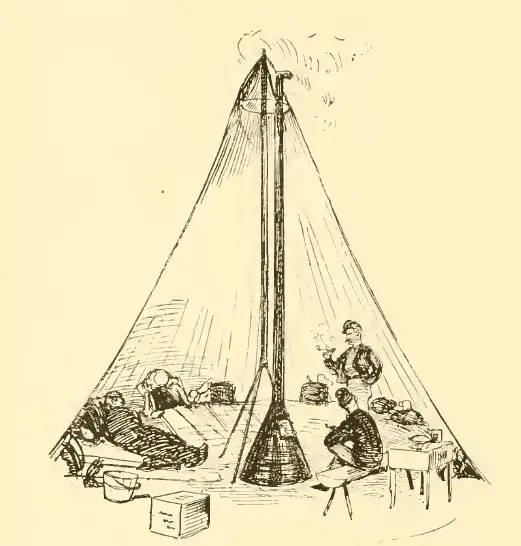
Once tents had arrived, they’d been ordered to set up camp in regulation style in a field within the angle formed by the main and Lebanon branch tracks. The countryside was largely wooded, broken up by fields here and there, sometimes sliced by a road, stream, or split-rail fence. The tents themselves were perhaps the greatest disappointment yet, as it had not even occurred to Cate that they’d have anything other than wedge tents sleeping two fellows each, like they’d had at Fort Snelling. Instead, they’d been with supplied Sibley tents, tall and conical like an Indian tipi, sleeping a whole squad in each.5
She’d spent the trip from Pittsburgh to Kentucky certain no privacy could be had until they camped. She hadn’t even considered that any scrap of privacy they could have scraped together would be their last safe harbor. She’d put aside her finer feelings, her longings and wantings and lusts, with the assumption that they’d have a chance at the front in a tent all their own. She’d been dead wrong.
Despite this frustrating setback, Henry’s hand-holding had carried on in the Sibley tents these past few weeks and thankfully, no one seemed to notice. In fact, as members of their squad fell like dominoes to the illness that was plaguing their camp and the desolation and mundanity of this cursed place sank into their skin deeper than the damp, looking for a touch of comfort among one’s comrades seemed increasingly a matter of course. But even if seeking warmth near one’s bunkie was nothing to write home about, there was a good deal more she had been hoping to find in the comfort of Henry’s arms and being back to assigned lodgings with the rest of the squad was frustrating to say the least.
Cate’s head pounded as she took in a wheezy breath, and she realized belatedly that her shovel was listing. Damnation. She stumbled and fell on one knee in the mud, hanging onto her shovel handle for dear life to keep the rest of her from going into the mire too.
“Charley?” A hand touched her shoulder, and she looked up into Henry’s concerned face, rain dripping off the end of his nose. “You don’t look so good.”
“It’s nothing, I just got distracted and tripped—” she started, but her voice was hoarse and rough and it irritated her throat, sending her into another fit of coughing. Elias Hower appeared in her field of vision as Henry helped her to her feet with a solid hand.
“I mean, he doesn’t look that bad,” Hower commented, raising one brow and studying Cate like he suspected her of exaggerating her symptoms. “That ain’t nothing compared to Webster a few days ago.”
Henry gripped her hand and held her steady. Her fingers felt weak and small inside his. It was infuriating. Osborn materialized behind him.
“Smith, do you need to go to the hospital tent?” Osborn asked, leaning in and looking at each of her eyes in turn.
Cate pulled herself upright, snatching her hand away from Henry to show she could stand on her own. “No, sir,” she replied, trying her best to sound like she didn’t have a frog in her throat. “I’m just a little under the weather. Nothing a little light exertion can’t solve.”
Osborn, Hower, and Henry all peered at her skeptically. She pressed her lips together and tried to focus her eyes, but it was hard when she could feel every heartbeat pounding painfully behind them.
“Schaefer, take Smith back to the tent and bring him some coffee,” Osborn said finally. “You don’t need exertion, Smith, you need rest. Take the remainder of the day and we’ll see you bright and early tomorrow.”
“Sir, I’m alright, really—”
“Wait, Sir, aren’t we on picket tonight?” Hower asked.
“Yes, but we’ll just have to go without Smith,” Osborn replied. “Get back to your tent, soldier, and that’s final.”
He walked away before Cate could make any further argument. The corporal glowered querimouniously and went back to swinging his hoe. Cate would have rolled her eyes at him, but it hurt her head, so she abandoned the effort.
Henry took her by her elbow and steered her to their squad’s tent. He pulled aside the flap and held it while Cate stepped onto the earthen floor. It was dank and dismal inside the tent, the only light filtering in from the small hole where the solitary telescoping tent pole went out the top of the canvas along with the stovepipe. The only virtue of the Sibley tents was that they were equipped with conical stoves that fitted neatly under the tripod legs of the telescoping tent pole.6
“Here, get set up on your gum blanket,” Henry said, handing Cate her wool blanket and her knapsack that served as her pillow. “I’ll be back with some coffee to warm you up.”
“Trust me, Schaefer, being warm isn’t the problem,” she croaked, wiping her flushed face dry as she sat down heavily. Her hands shivered in defiance of her words and she glowered at them as Henry slung their blankets over her shoulders. Then, he took up the poker and opened the Sibley stove, stirring the coals banked inside.
“Smith!” Williamson popped his head into the tent, followed by his lanky frame. “Heard you weren’t feeling well.”
Cate shrugged. “Yeah.”
“I brought you something to make you feel better,” Williamson said. He folded himself up like a long-legged spider next to his own bedroll and dug into his haversack, pulling out his tin cup. He dug a folded handkerchief out of his greatcoat pocket and one by one lifted the corners to reveal some wilted green fronds.
Cate curled her lip.
Henry craned his neck to see. “What’s that?”
“It’s yarrow. Can you believe it’s still green this late in the season? Kentucky, I tell ya.” He shook his head as though anything about Kentucky could inspire wonderment. Cate felt like she should have been following, but she didn’t know the first thing about plants.7
“What’s yarrow?” she croaked.
“Medicine,” Williamson replied. “It’s good for all sorts of stuff. It helps with colds, though it’d be better if we had the flowers instead of just the leaves.”
“Yarrow? Never heard of it,” Henry said.
Williamson blinked. “Really? Maybe it doesn’t grow in Germany.” He turned to Cate. “But you grew up here, didn’t you? Didn’t your mother give you cold remedies when you were sick?”8
“I didn’t have a mother,” Cate said shortly. Williamson looked properly chastened, so she decided not to rub it in, even though sometimes, especially when she was feeling sorry for herself, it felt vindicating to do that. But she still felt like she’d been hit by a train, and at the end of the day, she wasn’t about to turn down anything that might help. “I suppose my grandmother sometimes gave me elderberry cordial for a sore throat.”
“Yeah, like that,” Williamson said with a grin. “Elderberries are good too, but they’re out of season. Yarrow should work just fine.” He held out the handkerchief to her. Cate looked down at the fronds and stared for a moment.
“What am I supposed to do with it?”
Williamson pressed his lips together, as though he were disappointed in her ignorance but wasn’t so rude as to show it. “Brew it into a tea, of course.”
“Oh.”
“Here—I’ll brew it for you, since you’re sick,” Williamson said, standing. It was kind of him to cover for her ignorance. “I’ll be right back.”
The tent flap closed behind him, and Cate looked up sluggishly at Henry, who gave her his crooked little half-grin as he seated himself next to her.
“Are you warm enough?” he asked.
“I don’t need a nursemaid.”
“I know. I don’t mind.”
“You just want to get out of digging the rest of that ditch.”
He snorted and shrugged. “Are you gonna lay down and see if you can’t get some sleep?”
“In a minute.” Her eyes were drawn to the tiny flames in the stove, licking up the sides of a half-charred log, returned to life after Henry had prodded them. She sniffed loudly and let her breath out of her mouth, as it wouldn’t flow at all through her nose.
“I’m not sure what I expected from the front,” Henry commented after a few minutes, “but it certainly wasn’t this.”
Cate’s head sagged. “I know what you mean.”
Henry leaned back on his hands. “I guess I thought there would be a lot more … I don’t know. Peril? Battle, courage, heroics, glory—you know, all that.”
“I suppose that’s just what they want you to think so you’ll sign up.”
“True.” His mouth twisted wryly. “I don’t suppose we’ll be remembered for much if the rest of our service ends up like this.”
“The Noble Second, protectors of railroad tracks and diggers of ditches,” Cate proclaimed, her mirthless bark of a laugh devolving into a cough.
“The Sodden Guardians of Lebanon Junction,” Henry added. The two of them laughed, because what else could one do? It had been two weeks of misery and there was no end in sight. It was perfectly reasonable to imagine they might spend Christmas in this slough, sitting and waiting for General Zollicoffer to stumble upon them for a skirmish. Of course, by then they would all be too sick and miserable to resist. Perhaps this was all part of the Confederate strategy…
“Did you hear the Union took Springfield?” Henry asked, scooting himself nearer to her. Their thighs touched.
Cate shook her head and pressed her leg against his. His touch was reassuring in a bone-deep way that made her wary. “Missouri?”
“Yes. A Hungarian by the name of Zagonyi leading the body-guard for General Fremont went rogue. He charged over two thousand rebels with only a hundred and fifty men. They won and raised the Union flag at the Springfield courthouse.”9
“See, why couldn’t we have been sent to Springfield?” Cate lamented and let her head flop onto Henry’s shoulder.
“That’s what I want to know.”
“Maybe then I’d be cutting down rebels instead of coughing up a lung.”
“Don’t feel too sorry for yourself.”
“If I die in this mudheap without ever firing my weapon, disgraced and remembered only as that woman who couldn’t even survive a month of army camp, I’ll haunt every last one of you for the rest of your days.”
“You’re not going to die,” Henry chided, pulling his arm around her and holding her comfortably against his side. “I’m honestly a little surprised you’re being so dramatic. I imagined you would be more stoic after falling ill.”
“No. If I am able to act stoic, then the misery I feel would be imagined, blown up out of proportion like an unreasonable ninny. I am no ninny—therefore, I am clearly dying.”
Henry shot her a look. “Your logic is astounding.” He let out a long sigh. “How long do you think we’ll be stuck out here?”
“Until we all go mad and kill each other.”
“I don’t know, I’d be surprised if we were here much longer. It’s not a very hospitable place for setting up winter camp. And what with everyone getting sick, I don’t think it can really last that much longer.”
Cate shrugged dully. “The odds of us being sent outside of Kentucky are mighty slim. Lebanon Junction, Louisville, or the Cumberland—it’s all the same shithole as far as I’m concerned.”
When she glanced up at him, she noticed his discontented expression and looked away into the fire. She was ashamed to be regarded by him that way, but not in any mood to be more pleasant.
“Do you think the war will be won quickly?” Henry asked, his voice carrying an attempt at ease that betrayed anxiety beneath.
“After that victory at Springfield, I suppose it might be. But Balls Bluff was a disaster, so perhaps not.”10
Henry groaned. “My brother was at Ball’s Bluff. Apparently the Union’s scouting party mistook a line of trees for tents and that’s how it all started.”
“That is utterly idiotic.”
“But with blunders like that, perhaps we’ll still have a chance to fight yet.”
“I suppose that is one silver lining.”
“Perhaps, if Springfield represents the success of the western front and Ball’s Bluff the east, then we are under the command of the more intuitive leaders and are more likely to bring victory for the Union.”
“That is very optimistic of you, but as you pointed out, the victory in Springfield was due to Major Ziggy-Zaggy taking the fate of the battle into his own hands in contradiction to his orders. So I have yet to see any impressive maneuvers coming from the top brass on any front.”
“Nothing gets past you.” His tone was deadpan and he lifted a brow at her. “And it’s Zagonyi.”
“Even at the edge of death, I’m still sharp as a tack.”
This earned her a squeeze. She turned her face to press her nose against his chest, drawing in his warmth and his scent and his comfortable firmness.
“…Charley?” Henry’s voice had gone down a level, both in volume and timbre.
“Mm?”
“…I’ve missed you these past few weeks.”
“I know…” Cate sighed and kept her face pressed into Henry’s chest, lest she dare look him in the eyes and attempt to make rational decisions. “Me too.”
She could hear the thump of Henry’s heart and how it paced a bit faster upon hearing her words. The shed in Pittsburgh seemed like a hundred years ago. It was a damned shame they’d had no opportunity to repeat it since. Even now, Williamson would be back any moment and shatter the tender longing sensation that rose up from her chest and choked her. She buried her head deeper until it passed.
“When this is all over— ” Henry began, his fingers brushing through the drying curls at the nape of her neck. “When the war is won, I mean, what … um … what do you plan to do?”
Cate swallowed hard, and her throat sorely protested. This question felt like a trap, one for which it felt like there was a correct answer but one she had no idea what it was or whether it was even something she could imagine giving.
“I don’t know,” she said. It was true. Miserably true. She turned her head and shrugged. “Maybe I’ll write a memoir.”
Henry smiled. “The Lady Soldier: A Memoir of the Fiercest Woman Since Joan of Arc.”
“Well, that seems a little overindulgent.”
“It’ll sell well on the book flyers.”
“What’ll you do?” Cate couldn’t help but watch his face from her vantage resting on his shoulder as she turned the tables on him.
“Hmm,” he said, looking thoughtfully at the stove. The pause had barely stretched ten seconds, but Cate found she couldn’t bear it.
“I suppose you’ll go back to New Ulm,” she cut in despite herself.
“Yes, I would want to go back there,” he nodded. “See my parents and brothers.”
“Maybe you’ll become a famous tumbler, running a circuit around theaters across the country.”
Henry burst out laughing, doubling over such that Cate was jarred from his shoulder and had to hold onto his bicep to steady herself. “Oh, that’s hilarious, no, I’m nowhere near good enough to do anything like that. Besides, Turners aren’t tumblers. The point is self-improvement, not to show off.”
“How very humble of you,” she replied and squeezed his arm appreciatively. He smiled and cast a fond look upon her.
“I suppose … if I survive to see the end of the war—”
“—Oh yes, that pesky contingency—”
“—I imagine I’ll probably find a homestead—”
“Near New Ulm?” She knew she was interrupting, but she feared what he might dream of. What he might expect or not expect, both of which terrified her in equal measure.
“Yes, I suppose so. It would be good to be near like-minded people.”
“Germans?”
“Freethinkers,” he shrugged. “At least Turners. As I’m sure you’ve noticed from Krüger, not all Germans are cut from the same cloth.”
“His cloth seems rather Catholic.”
“Very.”
Cate sat up and shook her head, smirking. “…I knew you were an Atheist.”
Henry groaned. “I’m not an Atheist. I don’t have any answers. I just want to ask questions.”
“I’m sure,” Cate replied, nodding with a skeptical brow and a jibing smirk.
“Aren’t you too busy wasting away to give me trouble about my religion?”
“Ugh, don’t remind me.”
“Will you go back to dressing … as you did before? When this is all over?”
Cate blinked. Her eyes slid over to his, and she said quite astonishedly, “I … don’t know.”
Henry tilted his head to one side, but said nothing.
“I … I suppose it all depends on what my conditions are after the war is done,” she said. “If I’m caught and dishonorably discharged, I will likely have to return to my family.” Her lip curled. “If I have no means of supporting myself, I’ll have no choice.”
“To your, uh, husband …?”
“Richard, yes. My father won’t give me safe harbor, I’m certain of that.”
“But if you’re not caught?”
“Then I will have more choices, I suppose. Continue on as I am now, find work elsewhere.” A thought occurred to her and it made her giggle. “Perhaps I’ll find myself a nice wife and stead a farm of my own.”
Henry’s eyes widened. “A wife??”
Cate laughed. “What? You know well enough a woman doesn’t need a prick to enjoy herself.”
“That’s not what I meant.” His brow was raised but his lips looked tense. “But ‘need’ is a strong word.”
“I suppose so. And if I’m honest, I’d miss the damn things, but if it were a choice between living in secret as a man or having to whore myself, I’d bid the pricks a cheerful farewell and marry a nice young lady in disguise.”11
Henry was most comically caught between amusement, confusion, petulance, and quite possibly arousal. Cate desperately wished she didn’t feel like she’d been forced through a laundry wringer. And also that they weren’t in a tent that would be invaded with muddy, stinky comrades at any moment.
“It’s odd,” she said reflectively, trying to clear her throat rather than cough. “I don’t really see myself as a man, doing hard physical labor for the rest of my life. But I can’t see myself as a wife and mother either. And given I’m not independently wealthy like Susan Anthony, there doesn’t seem to be a third option for me.”
“The army suits you well enough.”
“If we weren’t bogged down here in Pitsville watching train tracks, it would.”
Henry’s expression was rueful and it puzzled Cate for a moment. It made her want to grip his face and kiss it away, but she didn’t want to get him sick. Or herself caught. But she let the desire show in her expression anyway.
Tent canvas rustled and Cate looked down as Henry flinched back from her.
“Yarrow tea,” Williamson announced as he climbed into the tent steaming tin cup first. “For the ailing soldier.”
“Thanks,” Cate croaked as she accepted the cup gingerly by the handle. The cup itself was scalding.
“You might want to let it cool off a bit first,” Williamson admitted.
Cate breathed in the steam. She couldn’t smell a thing, but the steam felt good on her throat in any case.
“We should let you rest,” Henry said, shifting toward the tent flap. Cate pressed her lips together and nodded, feeling his warmth replaced with a bone-chilling draft.
“Thanks, Schaefer,” she said. “And thanks, Williamson, for the tea.”
“Don’t mention it,” Williamson replied with a little half-salute. The fellow really had no right to be so cheerful. Henry looked at her over his shoulder as he waited for Williamson to pass through the flap, his lips pinched in uncertainty.
“See you on the picket line,” Cate said.
Henry frowned and shook his head. “Not if I can help it.”
Cate stared at the tent flap long after he’d disappeared behind it, huddled into her blankets. She was making out pretty well today, all considered, if success was measured in the number of fellows nursing her ill health. Despite being stuck in a tent in a disease-ridden muck-hole in the middle of nowhere Kentucky, she thought it might have been the most she’d ever been looked after while being sick. She wasn’t sure whether that reflected poorly on her upbringing or warmly on her comrades. Both, she supposed.
She blew on the edge of her cup and took a sip of the tea. It was bitter, but not wholly unpleasant. It felt good on her swollen throat.
“Hm,” she murmured consideringly at the cup. It wasn’t any hardship to drink the rest of the tea.
⸻
Footnotes
- Sioux was the commonly used term for the Dakota among settler-colonists in Minnesota, forever enshrined in treaty language even though it seems to have been a derogatory Franco version of an Ojibwe word for ‘snake’. The Dakota bands Henry means to refer to here include the Sisseton, Wahpeton, Mdewakanton, and Wahpekute. ↩︎
- These events are documents in both William Bircher’s Drummer Boy’s Diary and J.W. Bishop’s The Story of a Regiment. ↩︎
- J.W. Bishop’s The Story of a Regiment. ↩︎
- Ibid. ↩︎
- Sibley tents were conical shaped tents modeled after the Oceti Ŝakowiŋ (Seven Council Fires—known at this time as the Great Sioux Nation) tipis and slept anywhere from 8-12 men. Men would sleep like spokes in a wheel, with their heads out and their feet together at the center. Sibley tents had the appeal of being able to accommodate a fire, which vented at the apex of the poles, but were large and cumbersome to carry for troops on the march. Sibley tents were named after Confederate Henry Hopkins Sibley, not to be confused with Minnesota’s Henry Hastings Sibley. ↩︎
- Check out some sketches of Sibley tents at the Civil War Academy website. ↩︎
- This blog about Dakota traditional ecological plant knowledge was very useful to me in establishing the benefits of yarrow and the background of Williamson to have learned such knowledge from his mother. ↩︎
- Spurious; it grows all over, including Europe. Williamson just can’t understand why someone would have yarrow at one’s disposal and not use it for medicine. Henry hasn’t heard of it because its medicinal use in Europe is historically aligned with superstition, which is maligned by the Turners. ↩︎
- Nebraska advertiser. (Brownville, Nemaha County, N.T. [Neb.]), 31 Oct. 1861. Chronicling America: Historic American Newspapers. Lib. of Congress. ↩︎
- Learn more about the Battle of Ball’s Bluff from Battlefields.org. ↩︎
- This did indeed happen. See Redressing America’s Frontier Past by Peter Boag. ↩︎
⸻
Copyright 2025
All rights reserved. This is a work of fiction. Unless otherwise indicated, all the names, characters, businesses, places, events and incidents in this book are either the product of the author’s imagination or used in a fictitious manner. Any resemblance to actual persons, living or dead, or actual events is purely coincidental.
Printed copies permitted for individual personal use only. Duplication and/or distribution of this material, in print or digital, is strictly prohibited. Any fair use duplication of this material should be credited to the author.
Any use of this work to “train” generative Artificial Intelligence technologies is strictly prohibited. Be a part of celebrating and protecting the intellectual property of authentic human creators. Creation isn’t just about the product; it’s about the process. We lose much more in skills, processing, and practice than we gain when using AI technologies as a short-cut.
 Jane Hadley Writes