
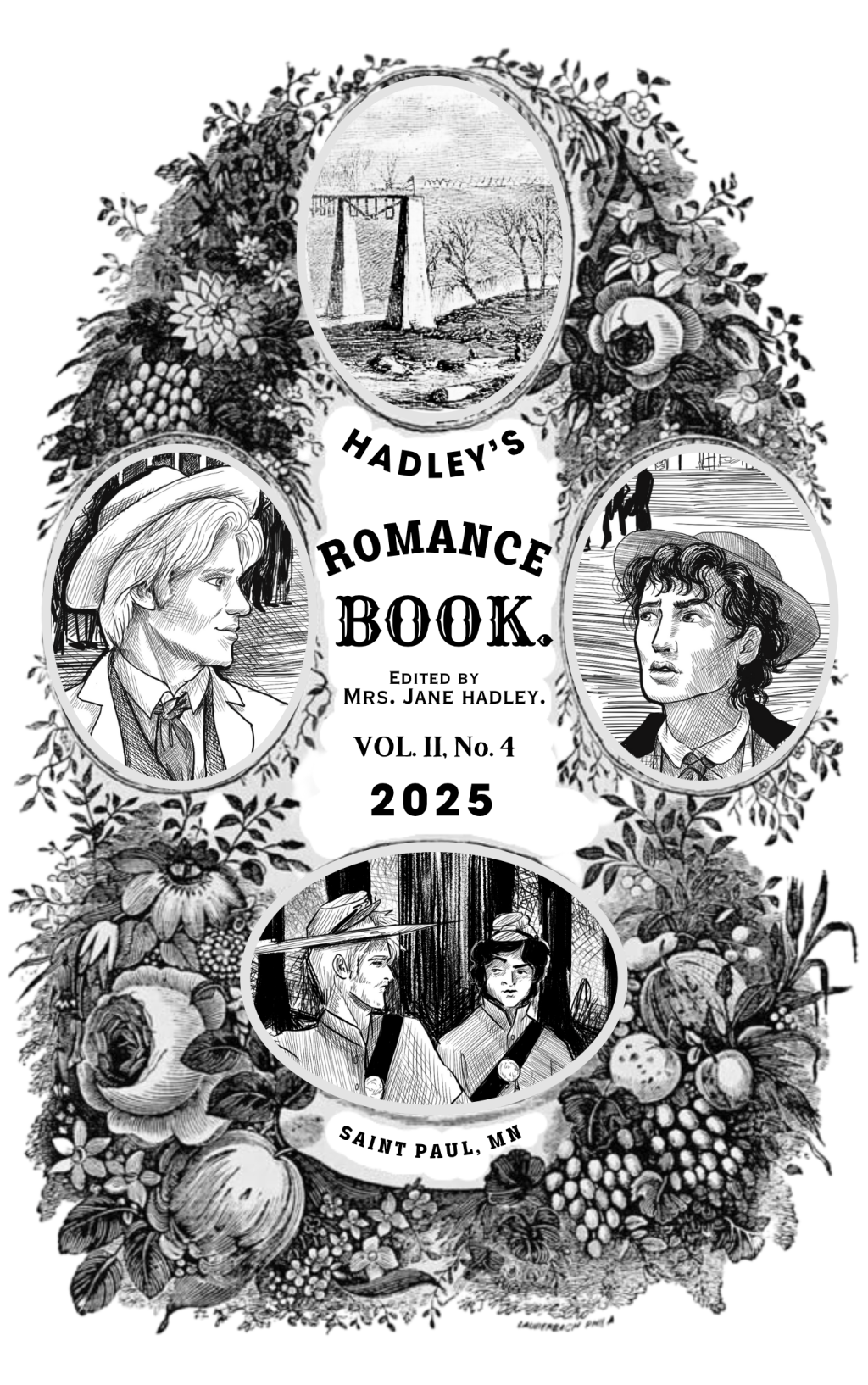
Vol. II, No. 4
Friday, JuLY 18, 2025.
St. Paul, MN
A RIGHT HONORABLE Soldier
By Mrs. Jane Hadley.
IN WHICH picket duty leads to crafts, heart-to-hearts, a convenient tree, and an infrastructural crisis.
VI.
Lebanon Junction, Kentucky
Sunday, November 10, 1861
CATE stood uncomfortably as men around her bowed their heads and prayed. She bowed her head too, of course, but her eyes remained stubbornly open. Losing one’s faith never failed to be surreal. Indeed, it wasn’t so long ago that her father had accused her of being a zealot. It had been scarcely five years since she’d fallen in hard with the Philadelphia Friends, though in hindsight she had fallen more into them, rather than in with them. The West Chester Quakers she’d grown up with had tolerated her better, though she supposed an outspoken grandchild of respectable parishioners wasn’t nearly as threatening as an outspoken, unattached young woman on a tirade for woman suffrage and abolition. At any rate, the debacle in Philadelphia had been a lesson in the admonishing, underhanded, and very human nastiness that was and had always been her experience in organized religion. Not even God could help an unpalatable personality like hers.
Cate glanced to her left and caught Henry’s eye. He was waiting for the prayer to be done too. He shot her a little quirk of a smile before rolling his eyes. She suppressed a grin and wondered what his Freethinker people were like. Were they as preachy against the gospel as so many were for it? She certainly didn’t mind a bout of Biblical moralizing in the name of a good cause, but Henry had seemed to chafe at it when they’d talked about Jane Swisshelm.1 She imagined Henry’s Freethinkers were probably just a bunch of arrogant, middle-aged men sitting around smoking cigars and tutting over how much smarter they were than everyone else. That’s all any religion was. Why should anti-religion be any different?
At length, the chaplain’s florid postulating on the state of their immortal souls concluded and they were sent off for a bit of leisure and dinner before afternoon drill. The squad was headed to picket duty that evening, so Cate splurged and bought an apple hand pie from an enterprising local at supper. The state of their rations were deplorable. If only she had known it could be this bad, she would have better appreciated the offerings at Fort Snelling. But here at the Junction, all they had available was coffee, a bit of hard tack, and whatever apples they could scavenge, which were few and far between given that most of the fall’s crop had been carefully harvested by local farmers and were sold to the soldiers at an outrageous markup. Since they had not been visited by the paymaster yet despite being enlisted for nearly five months, Cate had only what remained of the money she’d made from selling her hair, which was dwindling to a mere handful of pennies after months of being nickel and dimed, first by the sutler at the Fort, and now the Janus-faced Kentuckians who both exploited unpaid labor and Union protection.
She was doing her best to ignore her grumbling stomach and the leftover rasp in her chest as she walked with the rest of the squad to picket duty when the sky opened up again, sending down a sheet of drizzling, cold rain.
“Oh no, come on!” Robinson shouted at the sky, his hands up in supplication.
The others hunched into their greatcoats and trudged down the footpath to the river’s edge. The rain wasn’t terrible by the time they made it to their stations, sheltered as they were among the trees, but the cold and damp had been their relentless companions since they’d arrived in cursed Lebanon Junction. There were only so many weeks one could spend with one’s feet wet before one became irrationally grumpy about it.
They took up sentry positions staggered along the perimeter within shouting distance of one another, surveying their length of the riverbank and keeping an eye out for enemy mischief, which would presumably come from the opposite bank where reports put a rebel camp not 10 miles away, rumored to number 40,000 men.2 Except that they’d seen no evidence that that was even true and hadn’t for weeks. Cate suspected that the numbers had been grossly exaggerated through word of mouth. Probably the distance too. Maybe it didn’t exist at all. Maybe the entire report had been fabricated by command to motivate the troops to bear with the doldrums of Lebanon Junction.
The entire campaign at Lebanon Junction was to protect the railroad and the bridge that serviced it over the Rolling Fork river, the steep banks on which they were now stationed. Their officers had been singularly creative in the numerous ways they had found to describe how important their position here was, but the reality of it was, Cate was realizing, that they were wasted here. Freezing, wet, underfed and underskilled. As Robinson had most aptly put it, “Nothing to write home about. Nothing to leave home about.”
It was miserable. Which was much how she felt as she acquired her position, leaned up against a nearby tree, letting out a long sigh. The sun had set, as far as she could tell through the thick clouds. They were in for a long, cold, wet night.
The pine needles were drier than the oak and cedar leaves that had all but turned to mulch in the wet, so Cate took up under a Virginia pine. She sniffed under her collar. Soggy wool, a familiar musk, but she didn’t smell terribly bad. Before she’d gotten ill, she’d chucked her stays into the river in a fit of pique during the wee hours of picket duty. The tight-confines of the garment were a comforting shield for her chest, but they prohibited a standing bath. Which was the only kind of bath they could have in this godforsaken place. So she’d tossed it, and now she could enjoy scrubbing with freezing water under her shirt in the Sibley tent with the rest of the fellows. It was much more risky than she’d been willing to do in the barracks, but by this point, no one even looked twice at her. Lots of fellows washed modestly under their shirts—it was too damn cold to strip into their birthday suits anyways.
Getting rid of the stays had been the right call, but she missed them something fierce. It felt so strange to have her shirt moving across her chest as she bent and moved; she was used to fabric being quite affixed. Her skin was better able to breathe, but she felt exposed all of the time, even when the many layers of shirt and waistcoat and sack coat and greatcoat made her more wool than human. That, and her back ached. Ever since she’d first budded breasts, she’d worn some sort of rigid garment that gave firm support around her waist and chest. Without it, her muscles throbbed with fatigue.
All that was going to become inconsequential in comparison with managing her impending monthly courses in this crowded dungheap. They were due any day. It wasn’t uncommon for fellows to go off into the woods to seek a little privacy, and to avoid the stinking soldier sinks the Illinois regiment had left for them. But it felt exposing out in the woods, especially since she was affixing new rags in her trousers and wanted to keep her shirttails clear of the whole thing. Once the blood came, she was going to have a doozy of a time sneaking away to keep clean. At least the light blue trousers were now so streaked with mud any other stains wouldn’t be too obvious.
It didn’t bear thinking about why her monthly courses hadn’t come yet. They weren’t terribly late, and she was sure her illness had interrupted her cycle somehow, but she couldn’t help but wonder if her moment of weakness in that Pittsburgh shed was enough to set her on a path of imminent doom. It couldn’t possibly, could it? Not after months of managing to avoid a baby when Richard insisted on spending thoroughly inside her. She’d washed and fretted and used alum rinses and it had worked. There was no way Henry would succeed where Richard had so continuously failed when they’d done it only a day after her courses were through. Was there?
It didn’t bear thinking about, one way or the other. Thinking about it sure wouldn’t make the blood come. Cate pulled out her boot knife and started scraping away at a branch with it, for want of something to do.
She’d taken to mumbling “John Brown’s Body” under her breath when she heard the soft squish of boots in the wet leaves above the steady beat of raindrops. She looked up sharply and lifted her pointy stick like a rifle. “Who’s there?”
“Whoa, Charley, it’s me.” Henry appeared from behind a tree. “And you’re supposed to say ‘Halt.’”3
The warmth that glowed in her chest didn’t bear thinking about either. “Aren’t you supposed to be at your position?”
“Yeah, but I can’t see anything different than what you and Webster can see, so I thought I’d come downriver for a bit.”
Cate tried not to smile. She really did her level best. But sitting in the rain watching the darkness for nothing was slightly less dismal with company, and Henry’s company was admittedly the best of the squad. Even with his trousers on. Oh, to hell with it. She grinned.
“What are you making?” Henry asked as he leaned against the tree at Cate’s side and bumped their shoulders together.
“A sharp stick,” Cate replied, proffering it to Henry. He accepted it and inspected it lightly.
“Fearsome,” he drawled. Cate looked up at his crooked smirk and wondered what the rain would taste like if she licked it off his chin. He hadn’t shaved in a few days. It would be rough. God, she was lucky he couldn’t read her thoughts. She shouldn’t think like this, especially when there was a good chance those same thoughts could land her in a mountain of trouble. Much as she hated Lebanon Junction, the prospect of getting kicked out of the army was significantly worse. She’d do well to control herself.
Henry offered the stick back to her with an eyebrow raised, and she shook her head, flustered that some of what she was thinking might have been visible on her face. He shrugged and took the stick in his hands, considering it. Then he gripped it in one hand and launched it at a nearby tree like a spear. It ricocheted off the trunk, chips of bark flying as the stick and its shrapnel skittered to the ground.
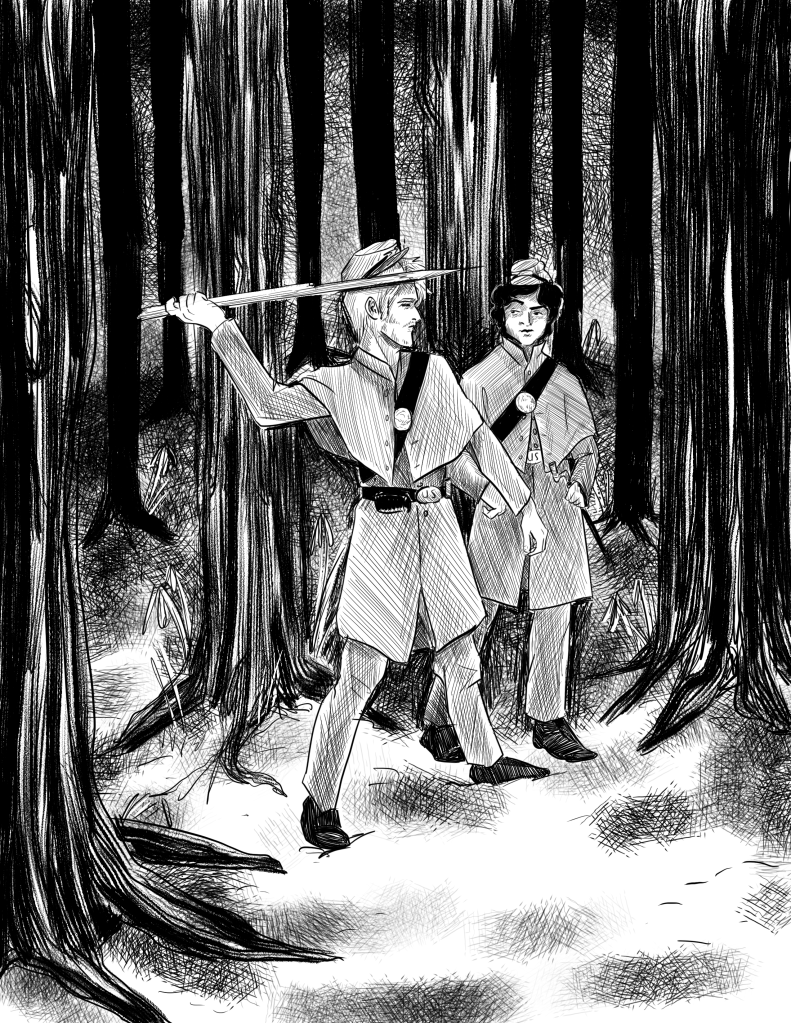
Cate watched for a long moment before she snorted.
“I can’t imagine why,” she laughed, “but I thought you were about to reveal some sort of … of spear proficiency. I was deeply mistaken.”
Henry grinned. “There are some Turners who throw javelins.”
“But clearly not you!”
He managed a self-effacing chuckle. “I told you I wasn’t any good.”
Cate turned, her eyes darting around the woods for a moment as she pulled herself against his chest. She bit her lip and craned toward him, his soft breath on her cheek erasing unsubstantiated fears and doubts.
“Hell,” Henry said hoarsely, hands settling on her waist. “Maybe I should take up javelin.”
“Why?” Cate asked. “I thought you weren’t any good?”
His lips quirked at the corners. His hands pulled at her belt, pressing her full against him. “I just like to hear you laugh.”
Cate hummed. Her fingers gripped his coat, and she pressed her lips to his. After weeks of cold, of sickness and damp and misery, the memory of his kiss melding with reality drove a hot wedge of longing into her belly. Any lingering shoulds or better-nots seared away. She couldn’t help releasing a little moan of relief, and he pressed his advantage as her lips parted.
A crack of underbrush, quiet but distinct, caught her ear, and Cate pushed away hard, just as Williamson sidled into view from the opposite direction that Henry had come from.
“What, no one told me we were partnering up,” Williamson complained as he approached. Cate froze her face in her sternest expression and forced herself to assume he didn’t mean romantically. Of course he didn’t. Don’t be absurd.
“We’re not,” she said, sparing a glance at Henry, who was doing an excellent job of looking awkward and guilty while leaning against a tree. He pushed a hand over his mouth as if wiping her kiss away, like Williamson might see the imprint of her mouth left on his. Cate couldn’t decide if his fumbling transparency was more irritating or endearing. “Schaefer was just making the rounds and we got to chatting.”
Just chatting. Face to face. With their mouths touching.
“Oh, okay.” Williamson’s eyes darted between them in puzzlement for a moment.
Cate was struck by a fit of inspiration. Surely, Williamson could easily be scared off. Because she was a harlot, plain and simple, and she wanted Henry to herself. Now. “Say, since you’re here, maybe you can give us your take. Schaefer and I are at an impasse and we could use someone to break it.”
Williamson shrugged. “Sure.”
Henry glanced at her. Cate smirked.
“The chaplain talked a whole lot this morning about patriotism and loyalty to authority, but I’m wondering to what degree does God wish us to do that? A few weeks ago a General Zaggy…”
“Zagonyi,” Henry supplied exasperatedly.
“Yeah, that. He refused to obey orders and took Springfield for the Union. So we were discussing the nature of loyalty …” She flagged for a moment. Henry picked up the thread.
“Right, the nature of loyalty and whether it is more patriotic to follow orders and keep to the plan or to cause chaos just to see some action.”
“You’re stacking it, Schaefer. The question is whether it is more patriotic to do what you believe is the right thing for the cause or to blindly obey orders.”
Williamson blinked. Cate and Henry watched him expectantly.
“I, uh…” Williamson shrugged awkwardly. “I don’t know that I’d strictly know any better than the folks in charge.”
“The folks in charge are men just like any of us,” Cate countered. “We’re all young and inexperienced. What makes them know any better than us?”
“Some of them are older and fought in the Mexican War—” Henry pointed out. The fact that he was playing along—and much more smoothly than Cate anticipated—made her stomach curl with pleasure like a dog on a hearth.
“—But they’re still making us sit in mud for weeks on end for what?” Cate charged on. Williamson shrank somewhat. He’d never been much for debate, which was exactly why this was going to work.
“Well, they’ve got a lot more information about the lay of the land than we do,” Henry cut in. Cate turned to face him.
“We could too if anyone would tell us what’s going on,” she shot back.
“I’m sure there’s no reason we need to worry about it,” Willimson begged off. “I’m gonna go check on the Corporal.”
Cate nodded absently and continued to barrel on about the dangers of too much authority concentrated at the top. Henry countered her as Williamson shrank back the way he came. When he was well out of sight, Henry seized her by the waist and pressed his mouth against hers. His lips were cold and wet and soft, and Cate went silent and pliant in his embrace. His unshaven chin scraped against hers, and it sparked sensation like flint on steel.
When Henry parted from her, he laughed. “Quick thinking, Smith.”
Cate shrugged. “I’m not about to spend the rest of the night speculating with Williamson about whatever’s going on at home.”
“Yeah. We left for a reason.”
“Just write them a letter!”
“I actually think replies aren’t coming through. Robinson is losing his mind over how many letters he receives compared to how many he sends, and Webster has been having the same issue too.”
“Ugh, Schaefer, stop being so gracious and understanding.”
“Sorry, I’ll try to be more unflinchingly judgemental.”
“Thank god.”
⸻
They kissed for a while against the tree, murmuring about how much they’d missed each other and how stupid the other was, which made no sense but was enjoyable nonetheless. Henry was just snaking his hands under Charley’s sack coat when she pushed them apart.
“We already almost got caught,” Charley apologized. “I don’t want to push our luck.”
Henry scarcely heard her. “Charley—what you got on underneath here?” He wriggled his hands back under her coat and caressed up and down her back to check.
Charley’s lips curled up with mischief. “I’ve expanded my options.”
“What’s that supposed to mean?” Henry complained, his fingers splayed across her spine. “You mean to tell me you’re bare under your shirt?”
“I’ve thrown those damned dirty stays in the river, but it’s hardly any of your—”
“Oh, I’ll make it my business.” His hands rounded her ribs and shoved up under her waistcoat, cupping soft, pliant flesh in his palms.
“Stop,” she said, and she was breathless and dreamy-eyed, but he obeyed nonetheless. Henry looked down scant inches, to her eyes dark and lust-blown, and wished for what seemed like the millionth time for some goddamn privacy.
“We could go down the bluff to the bank,” he whispered. “Out of sight of the picket.”
“We’ll be missed. Or drowned in the high waters. Or shot as enemies. You know I can’t take you quietly.”
Henry pressed his forehead against hers and groaned. “You’d do well to work on that.”
“I would if I had any chance to practice.”
“God, I want you again.”
“You have no idea how very much I concur,” she whispered in his ear. Her voice was thready, her wanting plain. She pressed her thigh against the growing bulge in his trousers. “You know Osborn will check on us soon. You’d better get back to your post.”
Henry inhaled sharply, seizing his self-control back albeit quite reluctantly. “Fine, yes.” But he kissed her hard instead of retreating, with his hand tight around the back of her neck and her hands clutched tight in his jacket.
It was yet another few minutes before he managed to withdraw.
⸻
The rain came down harder and harder. After a few hours and several quick jaunts back to Henry’s post just in time for Osborn’s rounds, they ended up sitting together under Cate’s tree, whose frail, brown leaves pretended to be enough to shield them from the cold bullets of rain.
“Did you ever read about that speech the Reb Vice President gave earlier this year?” Cate asked, her head resting back on the bark of the tree. They were soaked to the bone. She wouldn’t be surprised if they all woke up sick again in the morning.
“Who?”
“The Reb’s vice president. It was right before Fort Sumter, so it got blasted from the headlines. He said that the cornerstone of their confederacy is the so-called ‘great truth that the Negro is not equal to the white man.’ That slavery and subordination to the superior race is his natural state.”4 Cate looked down at the faint glitter of river water rushing beneath the bluff. The rain flashed in sheets in the wind. “They cheered for him so loud, no one could hear him over the din. And I hate them for it. I hate them, Henry. I think them less human, for believing that the enslaved are less human. So what does that make me?”
Henry regarded her thoughtfully. “A valkyrie.”
She smacked him in the chest, harder than was strictly playful. “Please do go to hell.”
“Only if you take me.” She glowered, but his eyes were still twinkling in the darkness.
“I mean it,” she insisted. “I cannot hate people for hating people. It makes me become what I detest. And yet, here I am, chomping at the bit to shoot them, and I cannot get myself to feel even a little bit bad about it.” She buried her face in her knees.
The tree bark scraped as Henry leaned forward, his broad palm resting lightly on her shoulder. “Do you believe there is a force for justice?”
Cate snorted. “No.”
“I do. But it’s not divine, Charley. It’s just all of us, together. Mankind, banded together by a common cause, fighting to make our dreams of justice a reality.”
“Heathen.” His hand dropped away. She missed it.
“It’s not God. It’s only us.”
“You sure have a way of making folks feel hopeful.” She looked over at him. His posture mirrored hers, hunching over his knees to stay warm. “No wonder no one’s ever heard of your little Freethinker group.”
“What sort of benevolent God would let children be sold from their mothers?” Henry replied quietly. “Let humans mutilate and defile each other? Answer some prayers but not others? That’s not benevolence.”
Cate held her breath and with it, the fear his words inspired in her chest. You could take the man out of the church, but it was very difficult to take the church out of the man. She assumed it was guilt she felt, but when she tentatively scratched the surface, she found the guilt flowing from the fact that she rather agreed with him. And that was … a bit terrifying. She looked up at him wide eyed.
“If there is a God,” Henry continued, “he doesn’t give a damn about us. We’re on our own. So yeah, you are a valkyrie. You will choose on the field of battle who will die. You will use your bayonet and your rifle to personally escort those sinners to hell. Because if we don’t do it, no one else will.”
Cate flinched as she swallowed down his words. The memory of the mobs prowling St. Anthony to restore Eliza Winston to slavery came to her mind. It had been more than a year since that happened. It seemed forever ago and also just yesterday. She recalled her free-Black neighbor Emily Grey’s eyes, standing outside her house in the rain as Cate’s father and his posse ransacked her house, holding her infant son. Toussaint died shortly after that raid.5 He should never have been forced to stand out in the rain—none of them should have. Perhaps instead of screaming at her father, making everything about her anger with him, Cate could have done some good by sheltering the family in her own home. Perhaps she could have had some real courage, instead of false bravado.
Cate risked looking up at Henry.
“That’s horrible,” Henry said. “What a hypocrite.”
“That’s my father,” Cate managed on her exhale. God, it was such a relief to be understood. He listened and he cared and she was never going to be able to stop looking at him like she was right at that moment. Like he was some sort of wild thing, something precious and rare. Like if she made too swift a movement, he’d dart away. Evaporate like a mist. Because he couldn’t possibly be real.
“Look at us,” Cate let out a mirthless chuckle. “We’re not debating to get rid of Williamson anymore. We just can’t help ourselves, can we?”
Henry shrugged. “It’s interesting.”
“It’s people’s lives,” Cate groaned. “Who cares what we think, looking in from the outside?”
“The Union Army, I suspect, even if it’s just to make sure we’re fighting for them.”
“I sincerely doubt most soldiers are concerned about the moral implications of their enlistment. Or if they are, they’re more worried about whether it’s justified to wage war to prevent secession. Most people I’ve met don’t give a damn whether the slaves are freed. If the Winston case was any indication, they actively don’t want them to be. At least not if it would hurt their bottom line.”
“Do you really think so?”
Cate shrugged helplessly. “I know so. I saw it happen.”
“Is that why you ran away?”
Cate frowned and glanced up at Henry. He looked like he was holding his breath, frozen like he was afraid he’d spook her if she moved.
“No,” she admitted. “I wish it was. But no.”
Henry waited while she gathered her thoughts. It took a long time. The roar of the river and the hammering of rain drowned out any other sounds and made it hard to think. She had official reasons why she left. She could have easily let him believe the reasons he’d already suggested. But she didn’t want to. She found herself sitting on the cold ground, shivering a bit, and longing to tell him the whole truth. Not because she had to, but because she wanted to.
“I …” she began. “I mean, you know my marriage was bad. I had to get out of that.” She could feel his questions screaming silently at her through his gaze. “But that doesn’t explain why I had to disguise myself. Or enlist.”
She exhaled deeply. “I wanted to help the war effort and had complained about that for months. As soon as it started, really. But when I decided to run away, enlistment wasn’t … in the forefront of my mind.”
Henry’s brows furrowed. He hummed encouragingly, bless him.
“I just … I didn’t want to keep spinning in the same typhoon I’d been trapped in for so long. Even if I left Richard and went farther west or something, I’d still be a woman on her own. A person lacking the proper distinction. The proper supervision. Scraping by doing odd jobs. I can’t whore. I’m terrified of the prospect and it felt like such an inevitability if I were to try and be on my own with no money and no friends. But if I were a man? I could work lumber or stead a farm or learn the law. Henry, there are so many more choices when I put on trousers.”
Cate searched his eyes desperately. She was terrified he was going to be upset by her utter lack of femininity and moral resolve. But he wasn’t taken aback. He was nodding. Waiting for her to continue.
“So I just … pulled a suit of clothes from the laundry and I ran. I sold my hair and my dress and when I walked down the street, people stepped out of my way and …” She shoved her hands into her hair, knocking her cap askew as she buried her face in her knees. “And it felt so good. It felt right, you know?”
Henry hummed, and Cate dared to peek out at him. He was nodding.
“I still can’t imagine you in a dress,” he said plainly.
“It wasn’t a pretty picture, Schaefer. I was pretty pitiful.”
“I don’t know about that, because I think you’re very—”
“—Don’t start.” She rolled her eyes. “The Second Regiment gave me the path, the route to escape. What had been a fantasy became a tangible plan. And I realized I could finally do something useful, fight for something I believed in. Or fight against something I detested, more like.”
Henry hummed again, this time with the corners of his mouth curling up. “That’s a sight better than me. I only enlisted because I wanted to prove to my family I was worth something. And then I didn’t even get in on my first try.”
“You did eventually, though. And you’re better equipped than most of us to do the job and do it well.” Cate cast a significant glance on his arms and shoulders that made him look down bashfully.
Henry shook his flush away and went on. “And I do believe in abolition and amalgamation.6 Those causes do drive me, fill me with some fighting spirit. But I’d be a liar if I said I was here for noble reasons. I was trying to prove myself to my father. It’s really nothing more complicated than that.”
“And he’s proud of you.”
“He is. But, to be entirely honest, by the time I got that letter, I’d all but forgotten them. I didn’t miss them. I still don’t. I could have written them for months, but I avoided them.” He sighed. “I just needed to get away from them all. Be my own man.”
“I’m glad you didn’t get into the First Regiment.”
“Me too.”
“Because, even though you would have seen many battles by now, we would have never met. And I’m … really very glad we did.” Cate pointedly looked at the ground. She wasn’t sure she could face his feelings if they were anything other than mutual. His hand squeezed her shoulder.
“I’m very glad we met too.”
Cate squirmed for a moment, twitching with discomfort under the mantle of mutual affection.
“I mean,” she blurted, “if you’d ended up in the First Minnesota, you might have gone off to the front a virgin and ended up dying having never known the pleasures of the flesh.” It sounded funny and disarmingly charming in her head. Her head had been wrong.
Henry looked at her as though trying to decide if he was annoyed or amused. “If I had, you would have faced the same fate.”
Cate scoffed. “My flesh has known pleasures!”
He peered at her sidelong with incredulity. “At the hand of anyone else, though?”
She thought about his hands, broad and callused and eager to learn how to please her. It was a good thing it was dark, because her face was probably bright red. “Fine. Fair point.”
His grin lit up his face, and he leaned into her, grasping her cheek in his palm as he pulled himself closer. His lips dodged hers, pressing kisses to her temple, her other cheek, her ear, the side of her neck. He teased her with teeth and tongue as her breath caught in her throat. She gasped, “What about the others?”
“I’m just kissing,” Henry murmured into her neck. Poppycock. He wasn’t just kissing. He was seducing. Quite effectively. God, he was a quick study. She thought she’d better stop him, for propriety or something, but his touch was the only thing warm enough to cut through the bitter cold and relentless wet. He pushed his hands over her chest and she arched into his touch, her nipples stiffening and pressing toward him. God, she wanted his hands on her bare skin. She wanted him naked. In a damned bed. With a proper fire and proper privacy. And time. And contraception. She wanted to ride his cock, stretch herself around him, make him shake with pleasure. She was about to tell him all of this, to whisper it hotly in his ear, when the ground shook with an unholy crash. She couldn’t help it—she yelped in surprise as Henry sprang wildly to his feet.7
“What’s that?” he shouted. The rain battered his cheeks as the din continued, a creaking, groaning roar. It was so loud, it was difficult to determine where it was coming from. It felt like it was everywhere. Cate scrambled to her feet, unprepared for how heavy her greatcoat had become with rainwater. She stood in stillness for a moment, trying to overcome the confusion and fear and adrenaline to figure out what was going on. All at once, her mind coalesced.
“The bridge!” she exclaimed, snatching up her rifle. Henry seized his as well, and they waded up the mud-slick footpath toward where Williamson was positioned.
When they found him, Osborn was there too, with Krüger, and Robinson, who was shouting that the Rebs must have launched a cannon at the bridge or something.
“Robinson, calm down,” Osborn ordered uselessly, then gave up and turned to Henry and Cate. “It’s the water. It’s been rising all week and this storm flooded the river too fast.”
He stepped toward the bluff and pointed down where the water churned thick with clay and splinters of logs. Logs that had once been the bridge they’d been sent here to protect. Cate blinked against the rainwater dripping into her eyelashes and stared down into the rapids.
“What?” she asked uselessly as Webster and Hower dashed toward them.
“Was it Rebs? What’s going on?” Hower exclaimed, holding his rifle at the ready.
“Christ, Corporal, stand down,” Osborn said, agitated by the rifle pointed in his general direction. “It was just the river flooding with rainwater.”
“What the hell are we doing guarding a bridge that was about to collapse the moment a little rain came!?” Cate heard the bellow and realized belatedly that it was her. “We’ve been squatting here for weeks, men dropping like flies to illness! Company C’s Lieutenant died for Christ’s sake! For what!?”
She dragged her hands over her face, dashing rainwater away only for it to be replaced in seconds. “Why? All the Rebs had to do was wait for some fucking rain?”
Henry stepped to her side and put his hand on her shoulder. She jerked away and whirled toward Osborn, squaring her chest. “What the hell have we been doing, building earthworks and digging ditches? We should have been shoring up that hell-be damned bridge!”
The others stared at her pointed finger uselessly. Williamson held his own arms and shifted uncomfortably. Robinson still appeared to be reeling from his certitude that it was an attack. Webster’s mouth was set grimly as he looked from Cate to Osborn and back again. Instead of rallying their ire, she’d made them all uncomfortable.
Osborn’s mustache quivered, but his voice was calm. “I don’t know, Smith. We’ll have to report back and see what they say.”
Cate shook her head. “They won’t tell us anything.”
“You’re right,” he replied calmly. “They probably won’t.”
Cate opened her mouth to give him a piece of her mind.
“—Smith,” Osborn cut in. “I’m just a Sergeant. I don’t know what you want me to say.”
Her face tensed, bracing against the fury that wanted to geyser out of her. Fury at the incompetence of this entire outfit. Fury at Kentucky for being such a miserable contradiction. Fury at the long days of drill and mud and damp straw, chipping away at her resolve. Fury of her continued powerlessness, a different flavor certainly than the kind she had always known, but powerlessness nonetheless. And fury at herself for having so little self-control; at her own body for wanting Henry so much, for holding the monthly confirmation of her safety back from her. She’d given up so much for this. So damn much. She walked every day with the risk of getting caught, getting court-martialed, getting killed or dying by some horrific disease. And it was all just the same demon by another name.
⸻
VII.
Lebanon Junction, Kentucky
Thursday, November 28, 1861
HENRY was bedüdelt.8 While Smith had a point about Kentucky’s relative lack of any redeeming qualities, there was one thing it had in spades: apple jack. And if one were to imbibe in any amount of apple jack, surely a frigid Thanksgiving spent in the summer palace of the Sibley tent was the appropriate occasion. Especially since the feast was naught but their usual stale bread and coffee, with the benevolent addition of a rangy baked chicken and apples.9
The squad was arranged around a smoking tallow lantern in a circle, passing a glass bottle obtained from a nearby distillery through thoroughly unapproved means. Shadows danced across the tent walls. What little light there was flickered over their faces, casting the squad in grotesque shadow forms of themselves. Men were increasingly arrested for breaking the camp rules, which was entirely due to those rules being arbitrary and idiotic. In the dank, mud-slick camp, one had to find fun wherever one could.10
The evening had unspooled efficient evidence as to who could hold their liquor, as Jacob Robinson, Williamson, and Osborn were now collapsed together singing “Goober Peas” at an unbearable level. They were wrapping up yet another chorus when Williamson went green and scrambled out of the tent to deposit the contents of his stomach in one of the drainage ditches. He wasn’t the first of the night either. After so many weeks of salt pork and beans, coffee and hard bread, their stomachs were uneasy with fresh food.
“Hey Leute, let’s play Cerevis,” Krüger shouted, brandishing his worn deck of cards with one hand. Several of the others grumbled (nearly two months with nothing to do but play euchre with Krüger did that to one), and Henry furrowed his brow and replied, “How do you propose they do that if they don’t speak German?”
Krüger laughed and said, “They drink—that’s the point, natürlich.”
Elias cast a wary sidelong look at Krüger and made a point of engaging Webster in describing his children in excruciating detail, which he was near desperate to do whenever a little alcohol was in his cup. It took scarcely any effort to engage Webster in this topic, especially when he had alcohol in his cup, but the gesture was so obviously self-sacrificing, it was essentially equivalent to giving Krüger the cut direct.
It occurred to Henry that if Osborn weren’t so sloshed himself, they would be subjected to quite a lot of trouble, as their post was one considered by the top brass as constantly under potential threat. But the generals weren’t at Lebanon Junction, so how would they know that nothing interesting ever happened here? Tempting fate by enjoying a few bottles of apple jack between them was hardly a risk, given they’d spent the better part of two months here doing a whole lot of nothing. Besides, it was Thanksgiving. If they didn’t have a feast to pour their gratitude upon, they might as well pay three cheers to Bacchus and make do with what they had.
Henry laughed at Krüger. “Niemand will spielen, mein Freund.”11
Krüger glowered and rose, moving his bulk awkwardly toward the tent flap. He was larger and took his alcohol with more dignity, but the effect was still evident in the way his feet seemed to slide beneath him.
“Have it your way,” Krüger grumbled. “Dich brauche ich nicht mehr.”12
Elias’ eyes followed Krüger and once he was gone, muttered, “Good riddance.”
Webster frowned disapprovingly at him, to which Elias justified, “There’s only so many times a man can bear being trounced in card games before he learns not to play with that fellow anymore.”
“Krüger ‘as a gamblin’ pro’lem,” Williamson said gravely, though his hiccup rather undercut the intended gravity.
Henry’s eyes cast to Charley, who sat nearby, frowning into the neck of the rapidly depleting bottle. Her eyes were half-buried beneath her thick, dark brows and her lips were pursed thoughtfully in a way that made Henry lament how long it had been since he’d kissed them.
In the weeks since the bridge collapsed, Charley had changed. He wasn’t sure what he’d done or why she pulled away, but it was happening. It was subtle too. Little things, like she’d sit across from him rather than next to him. She’d provide clipped responses instead of engaging in conversation with him. His jokes landed flat. Something was wrong, and Henry couldn’t figure it out. He’d cataloged their guard duty in the rain before the bridge collapsed, and he couldn’t discover anything he’d done that would deserve such a direct cut from her. Maybe it was how he’d pressed physical advances? But he’d stopped as soon as she’d asked him to. Didn’t he? Surely she couldn’t resent him for that. And he’d kissed her, just before the bridge had gone down. She’d been so responsive—pliant, even. If she’d resented him for his advances earlier, why welcome him so clearly later? It made no sense. She’d been more open with him than ever before. Told him things they’d never discussed before. What could he have done? Trying to parse it out now, after a good dram of apple jack heated his blood, seemed futile.
“Something in there giving you trouble?” Henry asked, leaning in toward Charley and realizing a little belatedly that he was leering.
Smith winced at his sharp cider breath and passed the bottle to him. “Nope. Just need to breathe some fresh air that won’t get me any drunker.”
Smith rose and followed Krüger’s path from the tent. Henry blinked at the spot she’d disappeared through.
“Are you going to drink that or pass it on?” Elias asked covetously.
Henry shook his head and passed the bottle, then got unsteadily to his feet and went out the flap after Smith.
His hot breath split the crisp wintery air as he stepped out. His neck swiveled, looking for where Smith had headed. The railroad and the Junction Hotel, which were the only permanent structures for miles, rose up to his right while the rows of Sibley tents flowed in front of him and to the left. He caught sight of Smith nimbly picking her way around the drainage ditches they’d dug there, moving between the tents to the far side of the field, where a stand of trees marked the end of the camp. Henry gathered himself, doing his best to stride steadily after Smith.
He caught up near the edge of the camp, where Company I’s tents butted up to the treeline and gave way to the well-trod path to the picket line.
“Can I help you?” Smith snapped, whirling around to face him.
Henry stumbled a step back. “I was just—”
“Just what?”
“Wondering where you were off to…”
“Sure,” she hissed, glancing aside for observers. “Perhaps you’d be more convincing if you weren’t so sottish.”
Henry leveled a chagrined look at her, crossing his arms across the buttons of his greatcoat. Smith looked the few inches up at him and scowled, crossing her arms in reflection of him. They glared at each other for a few moments at the edge of the woods. Slowly, Smith’s scowl melted to reveal a more exposed expression, one that reminded him that Charley was still there, lurking beneath the prickly exterior. It was too dark to see her properly, but he could have sworn he read fear in her eyes.
“What’s going on?” he asked, dropping his arms from his chest and taking a step toward her.
Her lips were pressed into a thin line and her brow furrowed, her dark eyes studying him from under them. Then she looked off behind him, her eyes surveying the tents with the same inscrutability with which she’d searched him.
“None of it will matter, will it?” she whispered. Henry’s head jerked in surprise.
“None of what?”
“This!” she exclaimed, sweeping her arms to indicate the camp, the tents glowing from within while the muddy ditches crossing between them sparkled faintly with ice and frost. She shoved her hand through her hair, taking a deep breath, and then replaced her cap. “Keeping a train line open to the Union so we may route supplies to troops so we may maneuver to cut off the rebels so that we may force them back into our Union so that we may—what? Go on just as we had before?”
“Where is this coming from?”
Charley’s lips moved for a moment, piecing words together, then wiped her hands over her face. “Goddamn—it’s everything! Rumors going on about how the blockade might abolish slavery without the Union needing to do a damn thing. This government doesn’t want to speak up for justice. They want to keep walking that line, taking with both hands as they did for almost a hundred years, never having to take a stand for anything! We saw how well that worked, now didn’t we?”
Henry blinked. “Are you telling me you are under such great personal duress because of a rumor?”
She growled at him. “It’s not just the rumor. It’s this damnable post and this morally-bereft state, and … and …”
Charley looked up and her angry brows wavered. Henry stepped forward and curled her cold hands into his.
“I’m just so angry,” she whispered, her expression strained. “Everyone gave up so much to be here. I just want to make a goddamn difference. Dammit, Henry. What are we doing?”
“You gave up a great deal to be here.”
“Not like Robinson. He left his new bride at home. Or Webster, with his wife and children, good Lord. Three years from now they might not even remember him.”
“No, you gave up more. Because not only did you leave everything you had behind, you never even got to say goodbye.” Henry squeezed her freezing fingers tight. “You stand to lose a great deal more if you’re discovered, too. You take on just as much risk as the rest of us, but it’s that much more because of who and what you are.” Damn, apple jack made him earnest. He was leaning into her, hands joined, and he wanted to close the distance and kiss her, right behind one of Company I’s tent raucous with their own elicit whiskey and Thanksgiving revels.
Her eyes skittered away, like it was an effort to hold his gaze. “I don’t know if I can keep doing this.”
Henry flinched, his hands dropping hers. “What, you mean—”
“Any of it,” she agonized. “Maybe the army doesn’t suit me so well. Maybe I’m not cut out for this kind of life. Maybe I’ve been a fool, and I’m dragging my whole life into the mire—and for what? Some half-baked idea of justice and displaced vengeance that will never be realized? Because you’re wrong, Henry. There is no force of justice in the world. One can work and work and work and never see the fruits of one’s labor. Fate doesn’t care if you’re righteous or wicked—it tests us all the same.”
“I … I don’t understand. What’s happened?”
“Nothing. That’s the problem.” She tried to keep her face hard, but it broke. The soft firelight glow of the tents glinted against tears gathering in the corners of her eyes.
“What can I do?” Henry’s voice sounded more desperate than he’d like. She spread her hand over her face and grimaced with the effort to hold her expression firm. It hurt to see her like that, sobered him more than the cold ever could.
She took a trembling breath and her mouth pressed into a thin white line. “Just go,” she said. “Leave me alone.”
“But, Charley, I—”
“That’s not my name.”
She turned and stalked off down the path to the picket line. Henry stood, stunned, at the edge of the wood, the euphoric bubbling of apple jack in his veins going flat. He couldn’t understand what had happened, but the tightness around his chest made him certain that something significant had changed. Something that hurt deeply, that frightened Charley—or whatever her real name was. He hadn’t worried much about that before. Perhaps he should have. If he cared for her so deeply, should he not have wanted to know her true Christian name? He may have wasted away any chance he might have had to find out.
⸻
Footnotes
- Jane Swisshelm published an abolitionist newspaper in St. Cloud, MN and stirred up significant controversy when she accused a powerful local leader, Sylvanus Lowry, of illegally holding slaves in his household. Suffice to say, her printing press ended up in the river. So she bought a new one and changed her paper’s name to the St. Cloud Democrat (she was a staunch Republican; she was being facetious). She stayed in Minnesota until the US Dakota War, when she returned to Washington DC to advocate for the genocide of Dakota people. (She’s in some ways a good example of how politics in Minnesota was more about which group of people you were racist against rather than being for or against human rights. Republicans were more paternalistic toward Black Americans, while Democrats turned their paternalism toward Indigenous Minnesotans. None of them were particularly anti-racist, mind, and I would include Jane Swisshelm in that assessment.) ↩︎
- Letters from Bert Olmanson, Oct. 26, 1861. ↩︎
- “On guard duty, if he sees anyone, he orders ‘Halt’ three times, then if they don’t oblige, he is directed to shoot.” Griffin, David Brainerd. Letters Home to Minnesota: Second Minnesota Volunteers. Minnesota Historical Society, Stacks E515.5 2nd.G75 1992. ↩︎
- The Cornerstone speech was given in Savannah, Georgia by Confederacy Vice President Alexander Stephens a few weeks after Lincoln’s inauguration. Speaking before a raucous crowd so large they could not all fit inside the venue, Stephens asserted that the foundation of the Confederacy was unequivocally slavery and that Jefferson and other founders who had asserted that all men were created equal were wrong. ↩︎
- It’s unclear when he died. All that is known is that it was in 1860, shortly after he was counted in the census. Whether he made it to August, when the raid on the Greys’ house occurred, is not recorded. The Black community in territorial St. Anthony : a memoir / Emily O. Goodridge Grey ↩︎
- Abolition: the abolishment of slavery; Amalgamation: the integration of the formerly enslaved into American society (contrasted with the Colonizationists, who wanted freedmen to go back to Africa and form their own democracy; see Liberia and the Colonization Society) ↩︎
- Griffin. The bridge actually went down on Dec. 2 but I (gasp) took creative license. ↩︎
- Translation: Tipsy, sozzled, fuddled. ↩︎
- Griffin. ↩︎
- Ibid. ↩︎
- Translation: No one wants to play, my friend. ↩︎
- Translation: I don’t need you anymore. ↩︎
⸻
Copyright 2025
All rights reserved. This is a work of fiction. Unless otherwise indicated, all the names, characters, businesses, places, events and incidents in this book are either the product of the author’s imagination or used in a fictitious manner. Any resemblance to actual persons, living or dead, or actual events is purely coincidental.
Printed copies permitted for individual personal use only. Duplication and/or distribution of this material, in print or digital, is strictly prohibited. Any fair use duplication of this material should be credited to the author.
Any use of this work to “train” generative Artificial Intelligence technologies is strictly prohibited. Be a part of celebrating and protecting the intellectual property of authentic human creators. Creation isn’t just about the product; it’s about the process. We lose much more in skills, processing, and practice than we gain when using AI technologies as a short-cut.
 Jane Hadley Writes