


Vol. II, No. 5
Friday, August 1, 2025.
St. Paul, MN
A RIGHT HONORABLE Soldier
By Mrs. Jane Hadley.
IN WHICH the squad arrives at winter camp, Cate is scared witless, and Henry has an unexpected family reunion.
VIII.
Lebanon, Kentucky
Monday, December 9, 1861
CATE was certain it would make her feel better to get on the train, to travel across the endless Kentucky countryside to a new post, to get away from that shithole railroad junction. She sat on the hard bench in the train car, surrounded by other soldiers talking and jesting and carousing, waiting for the relief to come. But it didn’t.
Night had fallen by the time they boarded and the landscape was nothing more than vague shadows outside of the darkened train. Heavy gray clouds obscured the moon and after several hours, snow began to fall in thick, fat flakes. Henry sat with Robinson on a bench across the way and a few rows forward. Their conversation was lost in the din, but they were pointing out the window at something.
He’d listened to her, for once. They hadn’t spoken more than two words in a week and a half. It hurt and she missed him, but it was no more than she deserved. She should never have sought his company in the first place. The weakness she harbored for him was indeed going to be her undoing.
The train chugged eastward, toward the location of their winter camp at Lebanon, Kentucky. The small town had been selected by General Thomas as his headquarters for the Army of the Ohio and a vast force was ordered to winter there on the outskirts of town. They rode on the line for a few hours, departing from Lebanon Junction as soon as the Third Minnesota Regiment had arrived to relieve them. The news of their arrival had been the only thing keeping Cate’s head above the murky depths of despondency.
Cate shifted in her seat. As much as getting rid of her stays had convenienced her as far as keeping relatively clean in close quarters, her lower back and shoulders still ached. Her back wasn’t used to supporting her weight all on its own. Drilling was especially tiring. Part of her worried that she was showing evidence of the implicit weakness of women, made plain by her body’s inability to perform without a support garment, but she’d left herself without an alternative. It had been improving—before this cursed uncomfortable train ride—so she hoped it was a matter of getting accustomed and nothing more.
The train began to slow, and she leaned out her southerly-facing window—no more than an opening in the side of the train—catching sight of a shadowed train depot up ahead. There was a small cluster of brick buildings beyond it, the epitome of a Western train town. The candle-lit windows stood in stark relief against the rolling hills of farmland. There were some higher areas, some shadowed hills and gulches, to the south, but otherwise the landscape held hardly anything with which it might distinguish itself.
Steam poured from the engine and engulfed the station platform as the train ground to a halt. Cate stood from the wooden bench and shouldered her knapsack, falling in among the others. Her stomach clenched in response to the movement, and she couldn’t tell if she was hungry, ill, or having some sort of stomach cramp. Probably some combination of all three. She had lost hope that it was a sign of her monthly courses. Those had been late for several weeks now, and she was beginning to resign herself to the idea that … that something was immediately wrong.
Not a day went by that she didn’t regret having Henry in that shed. She felt nauseous often, nursed a near constant headache, and she was always hungry—although subsisting on hardtack and salt pork for eight weeks was not precisely satiating—and of course, the most damning sign of all: her blood had not come. The mere thought was enough to make her feel as though she couldn’t breathe. Her moment of weakness in Pittsburgh haunted her. She was entirely out of her field of experience and had no one to turn to for insight or advice. She could only wait and see what other changes came next.
She shook her head, making it pound painfully and draw her out of yet another cycle of speculation. Worrying never accomplished anything. What was done was done. She would cross each bridge when she got to it. Providing none of them collapsed in a flash flood.
Now that they were in a proper town, presumably with a druggist and physician, she might manage to acquire a solution that would prevent her from having to reveal her secret and return in humiliation to St. Anthony to await the judgment of her idiot husband.
The Second shuffled out of the north side of the train to the passenger platform and loitered there for a few minutes as the Colonel spoke with a local man on the street below. Then, they were all herded into the depot itself.
“There isn’t time nor light enough for us to pitch camp,” Osborn relayed as they all grumbled. It was a tight fit for them all in the depot, though Cate was glad that they were out of the snow falling outside.
Henry made a point to face away from Cate when he curled up under his wool blanket. She laid on her back, studying the shadows in the depot’s rough-hewn beams for what felt like hours before she finally dozed off.
The next morning, the Second emerged from the depot to be greeted by a group of gently-dressed townspeople, mostly ladies and a few older gentlemen. The lieutenants ordered the soldiers down the platform to the dirt road alongside the railroad track and had them fall into ranks. Lebanon was the end of the line. It felt odd to gather in rank in front of the train that had no further path forward. North and East of the town, Cate could see the tips of Sibley tents poking up on the horizon.
The Lebanon greeting committee stayed upon the platform and as the last of the Second fell into ranks, the committee gathered at the edge of the platform, as though it were a stage. The Black laborers—likely enslaved, Cate couldn’t help but remind herself—heaved crates of supplies from the train cars on the opposite side of the platform, in stark contrast with the delicate, well-trimmed white people of the welcoming committee. An older gentleman stepped forward to speak.
“Salutations, Colonel Van Cleve, Lieutenants, Captains, and soldiers. Welcome to Lebanon! I am your humble servant Mayor Benedict Carlisle, and I know I speak on behalf of all of us loyal Lebanonians when I say you are most welcome in our town.”1
“Lebanonians,” mumbled Robinson to Henry, just ahead and left of Cate. “Say that three times fast.”
The mayor went on to expound at length about the virtuousness of their mission, of the appreciation held for the Union and its soldiers by those living in the town, and the graciousness of Southern hospitality as though their state weren’t being occupied in response to the threat of secession. It was more of the same tactless claptrap, going on and on about saving the Union and protecting the integrity of the Constitution and states’ rights and all of the political nonsense with which the morally corrupt gilded their complicity with slavery. Cate’s eyes flicked back to the Black laborers and let her anger simmer. It felt much better to be angry than it did to drown in uncertainty.
“We are delighted to extend to you our hospitality, and please don’t hesitate to make yourselves at home here in Lebanon through the duration of your stay.”
The ladies descended the steps and greeted the officers who stood at the front of ranks, smiling demurely and murmuring their thanks for their service as they passed. The gentlemen, including the mayor, accompanied Colonel Van Cleve, his Lieutenant Colonel, and Adjutant presumably to headquarters, and the captains ordered the rank and file to march to camp.
Another regiment had already arrived and set themselves up just south of the village. The Second Minnesota began organizing their own camp on a dry hill just east of the existing camp. To the naked eye, it seemed obvious that the population of soldiers already easily outweighed the population of the town, which was the county seat to boot. Strings were staked, and Sibley tents were unloaded from the freight cars as the rising sun emerged fully from behind the distant mountains and melted off the inch or two of snow that had fallen in the night. The grass seemed unperturbed by the frost and sprang back green as their boots tramped it down for the floor of their tents.
They puttered around their campsite for a bit, coordinating where to stake the poles and determining how wide their fire pit could be without scorching their boots. Williamson unfolded the canvas and everyone graciously stood aside for him to hang it from the poles himself. Hower was even so kind as to provide several helpful suggestions as to how he might drape it more effectively. Suffice to say, Williamson was not nearly as amused as the rest of the squad was.
“So big news, fellows. We’ve been brigaded together with a few other regiments,” Hower informed them as the squad staked tent poles and draped canvas. “We’ll be with two other brigades to make up the First Division of the Army of the Ohio, which General Buell organized only a few days ago.”
For once, Cate was grateful for Hower’s penchant for the latest camp canard. At present, it was nice to hear that something seemed organized and that their regiment had not been forgotten at a desolate railroad junction due to poor bookkeeping.
“Is General Buell here as well?” Webster asked.
“No, he’s still in Louisville as far as I’ve heard. General George Thomas is charged with leading the First Division, so he’s the one setting up headquarters here. I understand that Zollicoffer and his Rebs are floating around these parts, and Thomas intends to set us off on his tail as soon as Buell gives the orders.”
“I’m glad the Rebs are using all their military know-how they stole from West Point to promote their friends,” Robinson said sarcastically, rolling his eyes.
“I can’t wait to give him his fair share of moral justice,” Cate growled, stomping a stake into the ground a little harder than strictly necessary.
“Dare I even ask what that entails?” Webster inquired.
Cate shot him a glare as she patted her bayonet scabbard on her hip.
“I’m going to be right back, fellas,” Hower said, his attention drawn away by the new regiment marching into the camp from the train depot. “I’m gonna see what these new boys are all about.”
When the tent was finished and rations had been collected from the commissary, Cate sat quietly at the edge of the campfire next door with the Hastings boys and the rest of the squad. There was actual bread instead of hardtack. Cate shoveled it into her mouth in huge bites.
“I understand Zollicoffer is entrenched on the Cumberland, building up and waiting for us to strike,” said Sam Corbett, one of the privates from Hastings. He had a stick in one hand that he used to absently prod the logs.
“Where did you hear that?” another private, John Martin, asked. “I thought he was headed here, and we’re being brigaded to head into a full-on battle within the week?”
Several of the Hastings boys looked at him with a renewed sense of excitement and urgency.
“Quiet, the both of you,” Corporal Harris said. “Neither of you are right.”
Then, he leaned in close to Corbett and Martin, seated side by side, and said, “Zollicoffer’s off in Nashville getting his cock shined by some hired belles, before he sets a’riding this way to meet his fateful end.”
“Now that has to be a rumor,” Williamson put in, stuffing a piece of bread into his mouth that was not only not hardtack, but was also only a day or two old.
“Did you know that Nashville has a whole city ward dedicated just to whores?” Jim Bates, a third Hastings private, said with a leer. “I’m gunning for an assignment to invade Nashville, myself.”2
Webster frowned at him, and at Corporal Harris too for good measure, before he stood and went off apace to stand with Osborn. Cate could understand why. The Hastings boys were not the most well-mannered young men, but that was why she liked them. They didn’t play games or put on airs. They were simply crass, and it was nice to hear the truth for once instead of placating platitudes that no one meant. Even if they did spend an inordinate amount of time talking about women like commodities to be acquired. At least they were honest about it.
Cate could feel her neck prickling, and she turned around to see Henry standing behind her and a few paces down. She looked away quickly and fixed her eyes on the flame.
“He!”
Cate looked up to see a group of men she didn’t recognize approaching the campfire. The man at the head of the group was tall and lean with a sheaf of yellow hair, and his voice was thickly accented when he spoke.
“Are you Elias Hower’s squad? He said there is a Turner in your—”
“Karl?!”
Cate looked up at Henry, whose mouth had dropped open and started pouring out German. It was strange to hear the words and not know their meaning, but the body language made the situation clear enough. Henry hurried around the campfire, spewing German, while the other man made some sort of excited exclamation and held his arms wide to receive him.
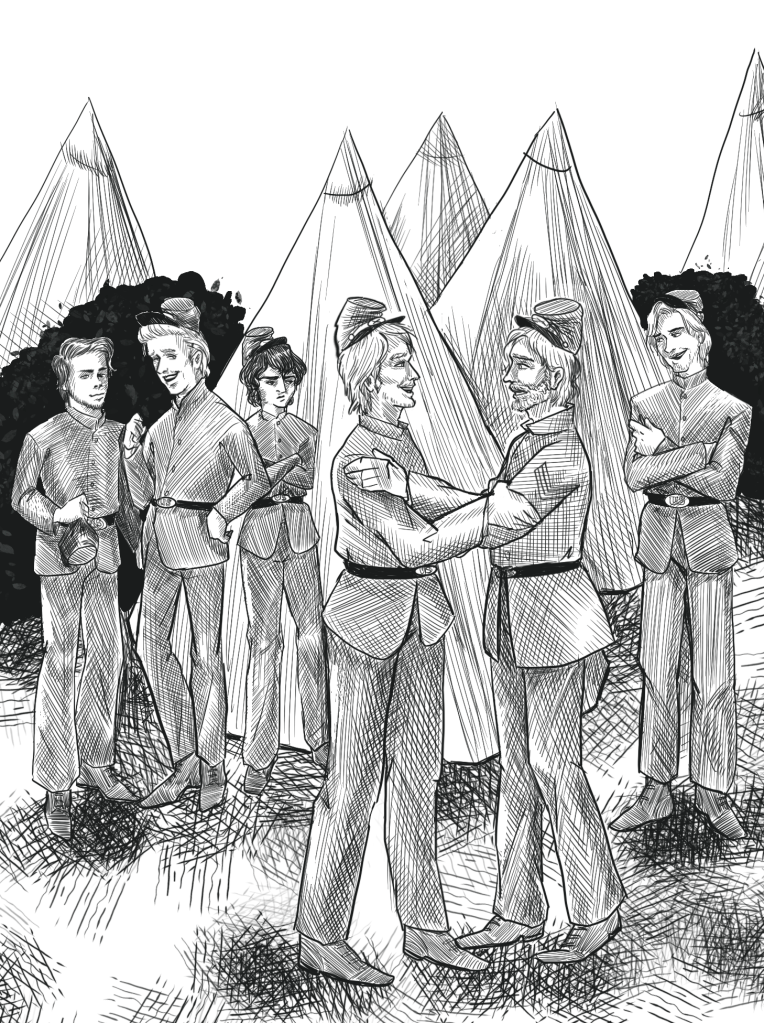
The eager exchange of German went on for a few minutes. The men who had accompanied the stranger were grinning excitedly, clearly understanding. Cate stood slowly as Hower approached.
“Ah, I see the Ninth found us!” he said.
“The Ninth?”
“The Ninth Ohio. They’ve been brigaded with us. They’re from Cincinnati and they’re all German.”3
“Cincinnati?” said Robinson. “Isn’t that where Schaefer’s from?”
Hower grinned. “Yes! I thought that too. Most of these fellows are Turners, apparently.”
Cate watched the joyful reunion proceed with little understanding. “Hower—do you suppose he knows that fellow?”
“It would seem he does. I didn’t meet him specifically when I was over there, I don’t think. Scarcely any of them speak any English.”
Henry was grinning ear to ear when he turned and dragged the man by the wrist over to where their squad stood to one side of the fire. He continued to natter away in German, so it was jarring to hear her name, along with their comrades, perfectly comprehensible couched in the middle.
“Das sind meine kameraden, Jacob Robinson, Charles Smith, und Elias Hower—Kennst du schon?”
The other man shook his head but grinned widely. His smile spread crooked on his face and though he was at least a decade older than Henry, they certainly looked akin. Cate fixed him with scrutiny. Cousins?
Henry finally seemed to notice how confused his squadmates were, because he suddenly looked abashed and said in English, “Sorry, fellas. I forgot you don’t speak German.” He laughed, like this was understandable. Cate held firmly to her annoyance and did not permit herself any tender feelings about the pink tinge of his cheeks. “This is my uncle, Karl Schaefer—my father’s younger brother.”
“Schön, Sie kennenzulernen,” Karl Schaefer said, then followed up in thickly accented English, “Pardon me—my English is not so good.”
The man’s apologetic smile was disarmingly charming. Cate stared at him while Jacob Robinson shook his hand emphatically. There were more of them—these Turners. Of course there were, she knew that. But a whole regiment full? That seemed … she felt like she should say problematical, but the idea was growing on her too quickly.
“Are you a Turner too, Sergeant Schaefer?” Cate asked, noticing the stripes on the uncle’s shoulder.
“Oh no, we don’t want you hearing too much of that, Schaef,” Hower piled on. “Don’t want you getting uppity.”
Cate found herself wishing Henry didn’t speak English as well as he did. Karl Schaefer was adorably confused as their squad slung English one on top of the other.
“Ah no,” Sergeant Schaefer said as Robinson finished shaking his arm off his shoulder. “Just Karl. Bitte.”
“Oh, yes, are you also a Turner, Sergeant?” Robinson repeated Cate’s question.
“Ja, yes,” the uncle confirmed.
“It sounds like the whole regiment is,” Hower said. Henry leveled a surprised look at him, then turned to his uncle and asked something in German. The response made Henry’s jaw drop.
“Well, that is wonderful news!” he exclaimed. “But of course the Turners were able to recruit a whole regiment. Why am I surprised?”
“Have you been in the field long, Sergeant?” Webster cut in, rejoining the group with Osborn as the excitement built. He glanced at Henry for translation assistance when it became evident that his uncle didn’t understand the question. A moment later, Henry relayed the response.
“They have,” he reported. “They’ve been fighting in West Virginia and have seen a few battles and skirmishes already.”
“Why an all-German regiment?” Robinson wondered.
“Can’t you see?” Hower replied. “They don’t speak English so they run the whole show in German.”
Henry frowned. “Well, yes, but it’s more than that. I imagine they are operating under German strategy as well.” He had a brief exchange with his uncle to confirm. “Yes, and they’re led by several German revolution veterans.”
“The Germans had a revolution? I thought it was just the French?” Poor Williamson garnered quite a few dirty looks from the Germans who did have a grasp of English. One of the men who had accompanied Sergeant Schaefer stepped forward, a hard look on his angular face.
“We Germans aren’t so quick to play fast and loose with the freedoms you Americans take for granted.” The man spoke with scarcely an accent, his tone hard enough to silence the group of them. His brow shadowed eyes that cut to each of them as they stood abashed, and then, out of nowhere, his long face slid into a wide grin. “August Kloepfer, at your service.”
The squad eyed him warily after that bait and switch. The man’s hand hung in the air for a moment before Cate took it and nearly winced at his vice grip. Henry’s uncle rolled his eyes and said something dismissive. August replied in quick, curt German, his tone suggesting he didn’t pay much mind to rank. The man’s eyes were confrontational, his smile easy, his shoulders carried with confidence. He spoke critically but wasn’t sullen, cantankerous, or combatant. He carried himself as though everyone should agree with him as a matter of course. Cate tried not to feel desperately jealous.
Henry cleared his throat and grinned at Kloepfer and the other men, as well as his uncle. He spoke German, then quickly translated himself into English, “Well, I can’t say how delighted I am that we have been brigaded together.”
“Yes, it was such a pleasure to meet you,” Webster said graciously, taking a turn at shaking Kloepfer’s iron fist. “Which reminds me, who are the rest of your comrades?”
Henry, by way of his uncle, made introductions to the other three men from the Ninth who had come along. All of them were solid, fit men with wide shoulders and square, angular faces. If Cate had known she’d meet a whole brigade of Turners, she might have waited Henry out just to see if she had any better choices. She attempted to amuse herself with the notion, but her heart was not in it. It was all she could do to force herself to even recognize the well-made men on display. Something was definitely wrong with her.
⸻
IX.
Lebanon, Kentucky
Tuesday, December 10, 1861
HENRY couldn’t believe it. What were the odds that half the Turners he’d known in Ohio would be brigaded here with them in this tiny little Kentucky railroad town? After morning drills, he went over to the Ninth’s encampment and met up with Karl, who paraded him around to all the old familiar faces from his childhood in Ohio. He saw Friederich Bertsch, his old Turner instructor, who was a lieutenant now, and Martin Bruner, also a lieutenant.4 Karl Joseph and Gustav Kammerling were captains. Once he wrote to his father of all this, he’d be surprised if he didn’t receive news of his father’s enlistment as well.
He walked side by side with his uncle, feeling a lightness and a sense of ease he hadn’t felt since leaving New Ulm. He was invited to join in warm-ups with a group of Turners set to practice hand-to-hand combat, and his body fell into the routine without a second thought. It was so good to be amongst Germans. He hadn’t realized how much he’d missed it until he was back in the midst of them, struggling to remember words and surprising himself with how rusty his German had become after the better part of a year away.
Karl invited him to eat luncheon together and the two of them sat in the unseasonably green grass, digging into fresh rustic bread and brisket with more gusto than Henry had ever done with the actual square meals they’d been provided at Fort Snelling.
“Have you heard much from your parents, then?” Karl asked around a mouthful of bread. God, it was such a relief to be socializing in German with someone other than Krüger. Though they were in the middle of the Ninth’s camp, where everyone spoke German and that was the point, it somehow made the conversation feel more private.
Henry shrugged. “Not much. I think Father wants to enlist.”
“I’m sure your mother is delighted with the idea.”
“Of course not. Who will escort her to Turner Hall?”
Karl gave a snort. “What does she think she is? A debutante in her first year out in Stuttgart? This isn’t 1840.”
Henry shrugged. Only he was allowed to complain about his mother like that. “She’s just scared. The Indians have been restless, and she worries.”
“Well, if your father has the right of it, they have every right to be. New Ulm is on their treaty land.”
“No, a land surveyor found that it wasn’t.”
“Did he then? And who paid him to say that?”
Henry furrowed his brows and took a bite of his own bread to cover his lack of a retort. The Turners had paid the man, of course. There was no squirming round Karl’s implication. His father hadn’t been among the first men surveying the town—that had been Frederick Beinhorn and the Chicago Turners.5 There had been multiple conflicts with the local Indians that had ultimately been put to rest by that official land survey. Even if the treaties did say that New Ulm was outside the bounds of the agreed upon reservation, the Indians certainly weren’t aware of that information when they signed. If Henry’s experience as a young boy with no English was any indication, the translation work available was shoddy at best, and certainly biased.
“So you’ve been in touch with my father?”
“Of course.”
“Then you probably have more news than I do.” Karl leveled a confused brow at him and Henry squirmed uncomfortably. “I, um, I missed out on enlisting in the First and I—”
“Yes, yes, I know,” Karl said. “He told me all. Judging by your expression, you know how stupid that was, and you don’t need me to lay into any more than your mother already has.”
Henry wrinkled his nose and nodded. “So you know that Peter is back home on sick furlough, too, then. That at least has Mother off my trail, for the moment anyway. Do you think Father will enlist?”
“I’m sure he will. He had better do it soon, or he’ll age out and they won’t want him anymore.”
“It’s too bad New Ulm can’t muster an all-German regiment like the 9th. This is amazing. Like taking home to war with you.”
“It is, isn’t it?” Karl looked around at the men milling about, their warm, lyrical German bouncing around the campsite. “Wishing you hadn’t left Cincinnati, then?”
Henry scoffed. “I was sixteen, I could hardly—”
“Certainly you could have. Sixteen is older than many of us were when we became Forty-Eighters.”6
Henry shrugged. “You know how my mother is. It would have been more effort than it was worth not to go, and besides, I didn’t mind. I was excited to be a part of creating the German utopia on the prairie.”
“And yet here you are. Trouble in paradise, then?”
Henry leveled his uncle with a discerning look. “No. I just wanted to make something of myself. To fight for something that matters like you and Father did. To do something with all that time we spent training and discussing what was right. One cannot have a utopia if one is not willing to fight to defend it.”
Karl smiled. His skin folded at the corners of his mouth now. Henry had always thought of him as a young man, but he must be approaching forty. Henry was used to seeing him in contrast to his father, whose staid stoicism always made the expressive Karl seem so young by comparison.
“I think that’s among the best reasons to enlist. I’m proud of you, nephew.”
Henry hated how good it felt to hear those words, even when they weren’t based on the whole truth.
“Is my father terribly angry with me? I mean, I had a letter from him before we left Fort Snelling, but it was brief.”
“No, I think he’s proud too,” Karl said. “I had a letter from him when I was in West Virginia, and he’d just learned you weren’t with the twins. But I think—even though he was vexed you hadn’t told them where you were—he was pleased that you’d gone off on your own. You were always lurking in Peter and Franklin’s shadows.”
Henry glowered. “Not on purpose…”
Karl raised a brow at him but said nothing.
“So what news from Cincinnati?” Henry asked, changing the subject quickly. “Did you ever end up marrying Marta?”
Karl blinked his blue eyes and then said, “Oh, that’s right, Marta. No, she ended up withTheodor Rapp. They’ve got two girls now, and a third on the way.”
Henry’s brows furrowed. “Teddy Rapp? Really? Why? What did you do?”
Karl’s lips pursed, and he shrugged. “Nothing untoward, I assure you. What about you? Do you have some young thing back in St. Paul, staring at your CDV and writing you letters every day?”
Henry couldn’t help but laugh bitterly. “No, nothing like that.”
“That sounds like a story.”
“No, it’s really not.” He sighed and looked out at the stretching plain of tents pointing into the cold, winter sky. After weeks of being shut out by Charley, it was a relief to get a taste of home. He hadn’t realized how lonely he’d been.
When Henry looked at Karl again, he could see his uncle was making quite a point of not pushing at him. The older man gave a wistful half-smile and said, “Story or not, if you want to talk, I’m happy to listen.”
Henry pressed his lips together. He’d spent weeks feeling confused and angry and miserable. No one had noticed, because they’d all been miserable in Lebanon Junction, but it was hard not to have anyone to talk to about it. Romance was already so confusing; it was even more difficult to not be able to bounce his experiences off someone else, to find out if he was being completely ridiculous or if Charley was indeed unbearably aloof.
“There was … someone…” Henry said reluctantly. “I’m not supposed to talk about it though.”
“You’re not?” Karl said lightly. “But you’re speaking German, surely this doesn’t count?”
Henry huffed a wistful half-chuckle and rubbed the back of his neck with one hand. “This person told me not to tell anyone about us.”
“What, is she married?” Karl said it jokingly, but the smile fell off his face when he saw Henry’s expression. “Oh no, Heinrich.”
“I didn’t know—not at first.”
“But once you found out?”
“I … certainly didn’t end things…”
Karl shook his head. “And now?”
“She’s ended it. And I don’t know why.”
“I should think you know full well why.”
“No, she’s left him. She’s not with him anymore.” Henry sounded foolish to his own ears—he couldn’t imagine what Karl must think of him. “She and I had a good thing going before we left Fort Snelling—”
“—‘We’ left Fort Snelling?” Karl leveled him with a paternalistic look. “Don’t tell me she’s a camp follower?”7
Henry’s mouth parted, but he didn’t say anything. Let Karl fill in the blanks for himself. It was easier than lying.
Karl sighed. “Sorry, I’m not trying to be judgmental. Go on.”
Henry swallowed hard. “I don’t know. We weren’t able to be together once we got to the front. These goddamned Sibley tents—there’s just no opportunity to be alone.”
“So is that when she ended things?”
“No, it’s just when we stopped, um…”
“I see. Were you careful? When you were ‘um’?”
Henry’s eyes went wide. “Yes! Of course. I …” Henry couldn’t bring himself to say it aloud so he made a vague gesture that he hoped Karl understood. “She assured me I had done nothing to compromise her.” His cheeks were on fire, but he couldn’t bring himself to say more. He had done something that could have compromised her. But he’d already violated his promise to her by talking of their relationship to Karl. It wasn’t anything he could bring into Karl’s confidence.
“Alright. So when did she end things?”
“Around Thanksgiving. We were friendly and then perhaps the week before Thanksgiving, she got prickly—but that wasn’t unusual because she’s normally like that, so I didn’t think there was anything amiss.” Henry pushed his hair back and replaced his cap with a sigh. “But when I tried to catch her alone, I could tell there was something wrong. She was scared, I think. And she told me to leave her alone. So I have. And that was two weeks ago. I—I didn’t think she meant it when she told me to stay away. She always blew a little hot and cold, which is why I was irritated with her. So I thought I’d make her regret her words, show her that she didn’t really want to be alone. I thought she’d come back but … she didn’t. She just looks past me now like I’m not there. It’s cruel.”
Henry’s voice broke on the last word, and he scrubbed his face with his hands. Karl didn’t say anything, and Henry filled that silence with shame.
“Heinrich,” Karl said, his brows knitted together in concern. “I’m sorry. I … I remember what that feels like and it’s awful. Just torture.”
Henry blinked up at him. “Did Marta do that to you?”
Karl shrugged. “It was a long time ago. Suffice to say, you deserve to know why. I wish I had asked. It’s torture to sit in uncertainty, going over everything again and again to figure out what you did wrong. If she’s still around, you should ask her. Get some closure at the very least.”
Henry squeezed his brows together and pressed his lips into a thin line to hide what a damned relief it was to talk to someone and to have them listen.
“Thanks,” he said instead.
“He Sarg!”
Henry looked up and saw August Kloepfer trotting up to them. He was a solid man with a protuberant chin and a long face like a horse that slid into a lopsided, rather silly smile when he saw Henry.
“Ho, what’s this? Our cousin from the prairie?”
Henry stood and began to return the other man’s smile, but then Kloepfer turned to Karl and said, “We’ve got drills now? Or what?”
Karl threw himself back into the grass and sighed. “Yes. We’ve got to make sure you can still load in nine even though you all did it flawlessly yesterday.”
“Got to keep in that fighting shape, am I right?” Kloepfer elbowed Henry in the shoulder and Henry stumbled back, surprised at how hard he’d executed what seemed like a casual friendly gesture.
“I had better get back to my regiment,” Henry said, rubbing his shoulder with a disconcerted expression.
“No, you should stay with us,” Kloepfer said. “Germans belong with Germans, after all. Besides, those Yankees don’t know the first thing about fighting. They haven’t seen battle since 1812. Well, except that invasion of Mexico, but hardly anyone fought in that.”8
Henry laughed. “Tempting but I’m not one to be court-martialed for desertion.”
“Ach, these officers. They hardly know their head from their ass. Present company excluded, of course.”
Karl climbed to his feet and dusted off his trousers. “I’m not commissioned, so no offense taken.”
Henry studied Kloepfer for a moment. He couldn’t remember ever meeting him before, though they were of an age. He was tall, gangly, but his shoulders showed he was certainly no stranger to Jahn’s gymnasticks treatise.9 He seemed to have no concern for what he said in front of whom, nor much care for social niceties. He regarded Henry with mischievous eyes.
“Well, little Schaefer, when you’re ready to see some action and kill some Rebels, you know who to march with.” He winked, then strode off toward their parade ground. Henry looked at Karl for some indication of how to respond, but Karl was still watching him go. Kloepfer seemed like a strange amalgamation of Smith and all the Hastings boys put together.
“Don’t mind him,” Karl said, rolling his eyes. “He’s a bloodthirsty bastard on the field and a damn imp in camp. He can’t stand tooling around waiting for something to happen. It makes him manic.”
Henry pursed his lips. It seemed to him Karl was unusually tolerant of what other officers might find untenable familiarity and insubordination. But it wasn’t any of his business.
He made a plan with Karl to explore the town after supper and bade his uncle goodbye. As he trotted back to the Second’s campground for drill, he wondered what he might say to Charley. He’d have to get her alone to even have a conversation, but Karl was right. He deserved to know what was going on. Her interest in him couldn’t have been contrived. Something had changed. And he deserved to know what it was.
⸻
Footnotes
- The mayor’s name, Benedict Carlisle, is derived from some wealthy landowners out of the 1860 Lebanon census. While the name of the actual mayor of Lebanon at this time is knowable information, it does not appear to be digitized. None of my Second Regiment diarists mention the name, alas. ↩︎
- Indeed, the Second Regiment does see Nashville, but not until years later. There was a brutal battle there in 1864 memorialized in an epic painting in the Minnesota State Capitol governor’s reception room. ↩︎
- This is by far the greatest gift my research gave me. I wrote Henry’s origins with the Cincinnati Turners without knowing that the Second Minnesota later brigades with the Ninth Ohio, a completely German Turner regiment from Cincinnati. The account of the Ninth Ohio’s service, We Were the Ninth by Constantin Grebner, has been a wonderful source, rife with inspiration and the kinds of real-life stories that you just can’t make up. ↩︎
- Friederich Bertsch was a real Turner instructor from Cincinnati who served as Lieutenant in Company B of the Ninth Ohio all-German regiment. Grebner. ↩︎
- Alice Tyler. “William Pfaender and The Founding of New Ulm.” 1949. ↩︎
- Forty-Eighters are what the men who fought in revolution in Germany in 1848. Many of them immigrated to the United States afterwards. ↩︎
- Camp followers could be wives of enlisted men, following their husbands and providing laundry, mending, and other services to the regiment for a fee. They could also be single women offering other “comforts” on the side, as documented in Thomas Lowry’s The Story the Soldiers Wouldn’t Tell. The Second Minnesota Regiment dispensed with any camp followers when they arrived in Lebanon, but Karl doesn’t know that. ↩︎
- The Mexican-American War, known abroad as the US Invasion of Mexico, 1846-48. This was the conclusion of the story of Texas independence, wherein the US annexed Texas, started firing on the border, then proceeded to invade and force Mexico to surrender nearly half of their territory, including California, New Mexico, Arizona, and Nevada. Mexicans at this time did not cross the border; the border crossed them. The war was highly controversial as it happened, and a whole bunch of people, including Henry David Thoreau, refused to pay taxes in protest of the invasion and were jailed. ↩︎
- A treatise on gymnasticks by Jahn, Friedrich Ludwig, 1778-1852; Butler, Charles, translator. ↩︎
⸻
Copyright 2025
All rights reserved. This is a work of fiction. Unless otherwise indicated, all the names, characters, businesses, places, events and incidents in this book are either the product of the author’s imagination or used in a fictitious manner. Any resemblance to actual persons, living or dead, or actual events is purely coincidental.
Printed copies permitted for individual personal use only. Duplication and/or distribution of this material, in print or digital, is strictly prohibited. Any fair use duplication of this material should be credited to the author.
Any use of this work to “train” generative Artificial Intelligence technologies is strictly prohibited. Be a part of celebrating and protecting the intellectual property of authentic human creators. Creation isn’t just about the product; it’s about the process. We lose much more in skills, processing, and practice than we gain when using AI technologies as a short-cut.
 Jane Hadley Writes